 Train2Game recently attended the Games Writers Panel at BAFTA’s headquarters in London. There, the Train2Game blog sat down with panellist Deus Ex: Human Revolution writer James Swallow. In an in-depth interview, Swallow discusses writing Deus Ex: Human Revolution, games writing in general, DLC, what makes a good games writer and much more.
Read part 2 below on the Train2Game blog, or onthe Train2Game Scribd page. Part 1 is available here, Leave your comments here on the Train2Game blog, or on the Train2Game forum.
Going back to Deus Ex, how have you fleshed out the narrative not only for the game, but for the novel, Deus Ex: Icarus Effect, which you wrote as well?
That was a lot of fun to do because I’ve already got experience as a novelist and when Del Rey Books approached Eidos and said they’d like to do a novel, they said ‘Why don’t you hire Jim, he already has experience?’ Basically I was the right guy at the right time in the right place because I had experience on both mediums so I could bring story that we hadn’t been able to put in the game. Say stuff that ended up on the cutting room floor, or stuff we couldn’t explain or explore in the in the game because we didn’t have enough time, I got a chance to bring it out in the novel and flesh out elements of story you don’t get.
With a novel you have the opportunity to get inside a characters head, you can show stuff from a completely different viewpoint. It was fun for me personally to revisit a world I had great time writing then write a story in a completely different way to writing a game narrative story.
You’re here at the BAFTA Games Writers Panel to talk about ‘Putting the protagonist in the hand of a player kills traditional narrative concepts,’ what’s your opinion on this as a writer?
When you’re a writer and you’re writing for a TV show or a movie or a book, you’re directing where a character goes, when stuff happens to them. You work that narrative and development for the right dramatic impetus.
In a game you can’t always do that because you can’t always know exactly where a player is going to be and you can’t railroad their experience and say ‘I want this dramatic turn to happen exactly here and you have to be standing here and do this thing exactly!’ because players might not want to do that, they might be looking at something else, they might want to be interacting with a completely different character. So you have to approach it in a very, very different way and it can be very difficult because you want to deliver story, players want to have a story delivered to them, but at the same time they don’t want to be railroaded.
So there’s a peculiar dynamic tension you get as a writer. On the one hand you’re being pulled towards the idea of giving players agency, having the ability to discover the narrative themselves. On the other hand you’re being pulled in the opposite direction which is you want to have a structured narrative that makes senses, that delivers the right dramatic impact at the right dramatic time. It isn’t an easy line to walk but it’s fun to do and I really relish the challenge of it because it isn’t often as a writer you get a chance to work in a medium that is so dynamic and so diverse.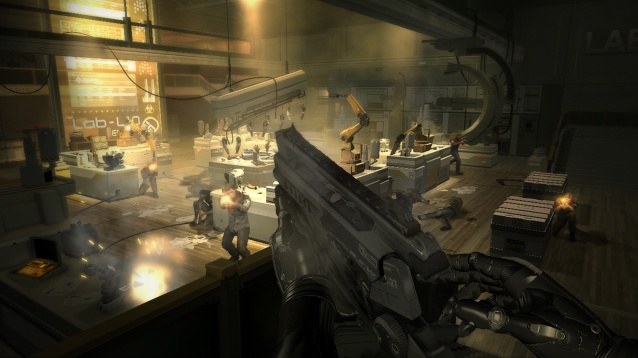
What are the key skills a good games writer should have?
Play lots of games, I can’t underline that enough. A lot of the games writers I know are people who have experience from other areas of gaming. The people on panel with me, for example, Andy Walsh has experience working in soap operas and theatre, there’s me with experience of working in radio. Rhianna Pratchett has experience of working as games journalist before she was a writer whereas my buddy Ed Stern has come up through the ranks purely involved in game design and games writing.
So there’s no one course into it you can take. I would say be a good writer first, obviously, you can’t be a writer without being a writer. But play lots of games, understand games, and try not to come at it just from a writer’s standpoint, but understand a bit about design and the way games are constructed. Listen to what level design guys and art design guys talk about, producers and directors, understand how they do their job because ultimately if you want to be a games writer you are going to have to interface and mesh with these people. So if you have an idea of what it’s like to walk a mile in their shoes, you can do your job a little better.
How did you get started in the games industry?
Purely by accident. I’ve been a games fan all my life and I love playing video games, I stay up way to late playing them all the time. I was actually doing some work for a magazine where I just happened to be covering a preview of a game release and one of the guys working on this game was actually using some material I’d written. He’d no idea that I’d actually written it. He said ‘We’re using this source material’ and I said ‘Really? I wrote that!’ ‘Really? We should probably hire you then!’ and that was it, I kind of stumbled into it. And once the opportunity came to get involved behind the curtain with games writing I thought this is something I really want to do.
Since then, for about the last 10 or 12 years now I’ve been working on one or two game projects a year as well as doing prose and script writing. It’s great fun, such a fantastic medium to be working with. It’s really rich for a storyteller because it’s so new and dynamic and I’m fond of saying this: there are no maps for these territories. What we’re doing is breaking new ground and a new way of telling story. I mean, who would not want to be involved in a new way of expressing your medium.
 So people who want to get involved in the games industry, with games writing, what advice would you give to them in order to get that critical first step in?
Definitely get yourself a good grounding in writing and don’t be afraid to work in a games project perhaps in a facility that might not involve being a games writer, like working in QA Testing. That’s always the sharp end of anybody, working in QA which is unforgiving grunt work but there’s no way you’re not going to learn about games other than that job. If you’re going to take that job, that’ll be what teaches you the most about the way that games work and the way games don’t work. I think it’s very important to play a lot of games to understand games and to understand narrative. If you can get those two things, you’re o n the road to becoming somebody who can write good game story.
Anything else you’d like to add about anything you’ve spoken about?
I’m really pleased with the way people have taken to Deus Ex: Human Revolution. Four years of my life went into working on that. I’m fiercely proud of it; it is without doubt the best games project I’ve worked on in my entire career because the story was really respected on that game and I’ve just really enjoyed being part of it. I want to thank everyone who bought a copy of it and I hoped they all enjoyed it!
Thanks for your time James.
Thank you.
Part 1 of the Train2Game interview with games writer James Swallow is available here.
For more information, go to www.train2game.com
BAFTA’s public events and online resources bring you closer to the creative talent behind your favourite games, films, and TV shows. Find out more at www.bafta.org/newsletter, www.facebook.com/bafta or twitter.com/baftagames
 The Train2Game Blog