Valve finished with episodic gaming

Valve logo

Any Train2Game students still expecting there to be a Half Life 2: Episode 3 may about to be disappointed, as Valve CEO Gabe Newell has said the developer is done with its episodic gaming experiment.

“We went through the episodes phase, and now we’re going towards shorter and even shorter cycles,” Newll told games industry magazine Develop. “For me, ‘entertainment as a service’ is a clear distillation of the episodic content model.”

The Valve CEO cited Team Fortress 2 as a successful example of a new model for game development. The multiplayer shooter released in 2007 has received over 200 free updates, some of which have introduced new items developed by fans. (Train2Game students take note!)

“If you look at Team Fortress 2, that’s what we now think is the best model for what we’ve been doing,” Newell said.

“Our updates and release model on [Team Fortress 2] keeps on getting shorter and shorter

Newell suggests that the development cycle for Portal 2 could evolve into a similar sustem.

“Portal 2? We’ll have to see how much our customers want us to push in that direction,” said the Valve CEO.  “In general, our approach is to come into work and ask ‘what can we do for our customers today’?”

As reported by the Train2Game blog, Valve has hailed Portal 2 as its best single player game.

Train2Game blog readers can find out much, much more about Valve and their approach to game development in an extensive feature on Develop Online.

So Train2Game, what are your thoughts on Valve giving up on episodic games? Does episodic content have a future? Or is a constantly rolling method of game development a la Team Fortress 2 the way forward?

Leave your comments here on the Train2Game blog, or on the Train2Game forum.

[Source: Develop Online]

Team Fortress 2 gets another Halloween Update

Valve has once again released a Halloween update for Team Fortress 2. Last year the Pumpkin Patch gave Team Fortress 2 players a new map, new hats and new achievements, and now Valve have released a second Halloween update – ‘The Second Annu-Hell Scream Fortress Hauntdead Halloween Special’

The Scream Fortress update introduces a new map Team Fortress 2 in the form of Mann Manor. It’s an Attack and Defend map designed by the winners of the Art Pass contest and features loads of spooky surprises including the first ever Team Fortress 2 NPC Boss Monster!  The Horseless Headless Horseman is randomly generated and can kill a player with one hit. Team Fortress 2 teams may have to work together to take him down!

The Scream Fortress update also introduces the Haunted Halloween Gift, a gift drop that drops randomly, and there are plenty of new hats and weapons – though some can only be purchased through the Mann-Co store and only for the duration of the Halloween Event.

The Scream Fortress update also comes with new “Ghostchievements” including one for killing the Horseless Headless Horseman.  You can also try to grab any of the Scarechievements you may have missed last year.

The Team Fortress 2 Scream Fortress event runs from October 27th through to November 8th and you can read more on the official Team Fortress 2 Scream Fortress page

So Train2 Game, do we have any Team Fortress 2 players in the house? If so, will you be involved in the Halloween event? And what do you think about the introduction of the Horsless Headless Horseman?

You can leave your thoughts on the Team Fortress 2 Scream Fortress update here on the Train2Game blog or on the Train2Game forum.

Rare Golden Wrenches to be destroyed for charity

The Golden Wrench is one of the rarest items in online gaming, with just 100 being randomly distributed to Team Fortress 2 players during the Engineer Update. Now the owner of Golden Wrench #31, a fellow who goes by the name of WiNG will be destroying his wrench, and all in the name of charity. He explains on the Golden Charity website:

“I’ve decided that perhaps Golden Wrench #31 is better served destroyed than remaining to exist. I also decided that, if I were to destroy it, why shouldn’t I try to make something good come of the situation? To create something positive of this utterly divisive, bitter issue? And for that reason, I’ve chosen to run a fundraiser to benefit the Child’s Play Charity, culminating in the destruction of the Golden Wrench. So far, this movement has gained the support of thousands, including 7 other Golden Wrench owners who have chosen to join me and delete their gold-plated play things for charity.”

The top 20 highest individual donators will be invited to watch the destruction ceremony take place on August 31st, and see some of gaming’s most sought after items reduced to nothingness in the name of charity. There’s still a lot of time before the August 23rd deadline for donations, but already the Golden Wrench campaign has raised over $6000, or almost £4000, to provide sick children with toys, books and games. If any Train2Game students wish to donate yourself, you can find out how on WiNG’s  Golden Charity page. Do you think more Golden Wrench owners will join in?

If you want to know a bit more about what’s going on, you can watch the video below. As usual, you can discuss this news on the Train2Game forum.

Polycount contest winners work to become part of Team Fortress 2

Get with it indeed.

The Engineer Update is still very much a new thing, but even more new items for Team Fortress 2 are already in the works. This time however, it isn’t Valve who’ve been the creative force behind new weapons and hats, but members of Polycount – a video game art and resource community.  (Perhaps our Train2Game Artist & Animator students should join the site if they’re not already members)

Valve and Polycount teamed up to members of the art community the chance to create items that will actually be used in Team Fortress 2. The brief went:

“Pick a single Team Fortress 2 class and create a minimum of three custom items for them. These items can be made up of any combination of weapons (melee, primary, secondary), Engineer buildings and/or hats. These items must be cohesively themed and fit within the Team Fortress 2 universe and time period. Make sure your replacement item set maintains the existing functionality of the original items they’re replacing, specifically any Primary, Secondary or Melee weapons you replace in your set.”

The content received an overwhelming response with over 70 sets – that’s at least 210 items – submitted by artists and designers. Now, Valve have managed to judge the entries and have selected five item sets that will eventually be released into Team Fortress 2. That’s after Valve work out how they’ll “attach gameplay attributes (probably of a game destroying nature) to these items.”  – Yeah, that quotes taken directly from the Team Fortress 2 blog!

which Polycount item sets will soon be available to all Team Fortress 2 players then?  Well, they are a heavy duty Tank Buster pack for The Soldier, a Milk Man themed item set for The Scout, 1950’s Gas station attendant gear for The Pyro, a nifty Saharan get up for The Spy, and finally ‘The Croco-Style Kit’ for The Sniper.  All of the items look very impressive and you can feast your eyes on them by visiting the Team Fortress 2 Polycount Pack Winners page.

Of course this isn’t the first time Valve have encouraged other Game Designers, Game Developers and Game Artist and Animators to contribute to their projects. After all, Counter Strike started as a community run fan project, while Portal was originally developed by students. Aspiring designers have already seen their maps and items become official in previous Team Fortress 2 updates thanks the Contribute! initiative.

Regular readers will know that this isn’t the first time I’ve praised Valve’s scheme and encouraged Train2Game students to get involved. It really does seem like it would be a good idea for Train2Game Designers to produce something. After all, you could strike it lucky and end up seeing your hard work on display in a game played by millions of people worldwide. Even if your items don’t get into the game, time practicing designing items can only be useful to your future career in the games industry.

So, what do you think of Valve’s enthusiasm for community developed items? Do you think you’ll be getting involved? How many of you play Team Fortress 2?

As usual, leave your comments here or on the Train2Game forum.

Developing for the disabled gamer

Last Thursday, I had an unfortunate incident on my bicycle which resulted in a strapped up broken finger and the misfortune of needing to wear a sling for a few days. Naturally, this caused me some problems – I could only type using one hand making updating this Train2Game blog and the Train2Game Twitter account a slow affair, cooking became a pain, and worst of all I was extremely limited to what video games were available to keep me entertained over the weekend.

With only one functioning hand, it was impossible to hold a console controller which meant continuing my ride through the American west with Red Dead Redemption was out of the question. It also meant that I couldn’t get my usual fix of Team Fortress 2 on the PC, after all a person needs to move by pushing keys with the left hand and look around by using the mouse in the right. (Or indeed, doing this the other way around if you’re left handed) Thankfully, I managed to keep myself from going crazy in a temporarily game free world thanks to the point and click interface of Dragon Age: Origins which kept me happy for hours on end.

Thankfully I’m out of the sling now and though I still can’t hold a PlayStation controller due to my fingers remaining strapped together, I’m back to happily fragging my clan mates on Team Fortress 2 online servers.

Luckily for me, not being able to play any video game I want is a temporary issue. Unfortunately for the significant minority of people who have disabilities, not being able to play a wide variety of different games is a permanent problem.

However, slowly but surely this tide seems to be turning, with small groups of Games Designers, Games Developers and Games Artist & Animators working with scientists to provide research into – and create – video games for those with disabilities.

Last year, Duke University in North Carolina conducted research into modifying Guitar Hero that allowed it to be played by man with an amputated arm. BBC News reporter Flora Graham explains how it works better than I ever could.

“To play the game, users wear electrodes on their residual muscles, such as those found on their chest and shoulder. The system translates the signals from the electrodes as if they were coming from the game controller, allowing players to strum along, despite not having any hands.”

The researchers also realised that the movements in the game were similar to those required when learning how to use a prosthetic limb, essentially meaning Guitar Hero could in theory be used to teach people how to use their new arms.

In May this year, a video game project called VI Fit was revealed that allows blind gamers to keep in shape. Researchers at the University of Nevada modified a Nintendo Wii for the project which according to Gamesradar;

“Features two games – VI Bowling and VI Tennis – and both can be downloaded for free at vifit.org. The game utilizes Wii remote controllers and a Windows PC with Bluetooth support. Players are instructed throughout the game with the use of both audio and vibrotactile cues”

EA have even got involved with developing games for the disabled, by helping VTree LLC, create a Madden powered title called My Football Game for players such as injured war veterans with physical difficulties.  These are just a handful of a variety of projects that aim to develop games for those with disabilities, there are plenty more of them out there too!

There is a significant audience of disabled people– and according to Popcap, they make up 20% of ‘casual’ gamers – who just want to enjoy their hobby in the same way that the rest of us do. It raises an important issue for Train2Game students, be they Games Designer, Games Developer or even Games Artist & Animator – Do you consider the needs of disabled gamers when you create your games? Or would you like to work on a game designed to be played especially by those with disabilities?

I’m very interested to hear your thoughts on this once, so as usual, leave your comments here or on the Train2Game forum.

The PC – The ideal platform for Train2Game students?

Dragon Age: proof of a popular PC game

My spiffing Train2Game colleague Gabe recently published a blog about PC gaming, and as what could be described as a ‘hardcore’ PC gamer myself, it got me thinking.

Gabe’s blog came following remarks from Bioware that the PC “is made for gaming” which seemed rather obvious to me. It should of course be obvious to anyone who’s played a Bioware Role Playing Game, be it Mass Effect or Dragon Age: Origins.

When it comes to these RPG’s, it’s the PC that’s king, and in an interview with CVG, Bioware designer and writing director Daniel Erickson says the numbers speak for themselves.

“Every two or three years we hear the announcement of fantasy being dead, PC gaming being dead and RPGs being dead, and yet, all of the biggest games that ever come out – that set the records – are nearly always PC games, and a lot of them are fantasy games.”

The biggest game in the world is a fantasy, PC, RPG MMO. We all know the drawbacks of PC. We all scream at our boxes and try to make stuff work. But at the same time, the interface is made for games. The mouse/keyboard interface allows so much less restriction [Than consoles]”

Personally, I’ve not experienced Dragon Age: Origins on a console  – I play it on PC – but it’s certainly obvious to me how much easier it must be to play on a PC as you can easily access spells and talents using hot keys 1-9 and the space bar easily pauses the action. I’d imagine the whole process is a bit fiddler using a control pad, but if you can do so, feel free to prove me wrong!

The PC certainly gives Train2Game students, be they Games Designer, Games Developer or Games Artist & Animator, an opportunity to test their skills thanks to the number of games with large modding communities.  Half Life 2 and Fallout 3 are just two games that a loyal fanbase who are giving others the opportunity to try new weapons, new skins or even whole games.  Counter-Strike, one of the most popular online shooters of all time, started as a fan produced Half Life mod and shows that with the right ideas, modding a current game could provide a small studio with a big break.

Some developers even encourage the addition of community content to their games, with Valve perhaps providing the best example of this with Team Fortress 2. Valve have run numerous community competitions calling on fans to create items in the form of weapons and hats with the winners being able to see their creations in game. There seem to be a lot of talented Games Designers out there, and Valve are going to have a tough time deciding on a winner of the most recent contest!

The PC is the most popular gaming platform, partially due to the rise in the popularity of flash games which in itself provides even more opportunities for Train2Game students to create games.

So what do you think? Would you consider creating PC games? Have you already made mods? As usual, let us know here on the Train2Gameforum.

Digital distribution – The Train2Game students best friend?

Digital and pre-owned games constituted one third of the United States market last year, with US consumers spending over $4.5 billion dollars on them according to research by the NPD Group.

It wasn’t so long ago that discs, or cartridges, were the only way for the consumer to purchase a video game. But thanks to the wonders of the internet, it’s now so easy to buy games without even leaving the house.

Of course, there’s the standard online shopping which allows consumers to buy the latest Call of Duty or FIFA through just a few clicks, but even then they’ll have to wait a few days for the postman to deliver what they want. So the gamer might be happy about not having to leave the house – because let’s face it, if we can avoid moving we will – but less pleased about not instantly receiving the game.

Digital downloads almost entirely bypass this issue. When purchasing a game, then downloading it, the consumer doesn’t have to wait long at all before they can play it. Of course, Train2Game has previously examined the discs vs. digital debate, but over the weekend I saw for myself just how easy it is for us download games – games that we may have had no intention of actually buying in the first place!

I like to relax – if relaxing can be defined as bellowing instructions to teammates down a microphone – by playing Team Fortress 2. Now, in order to play Team Fortress 2 I need to log into Steam, Valve’s content delivery system. When I logged in, a special offer popped up saying the Mass Effect games were on offer over the weekend only, with a whopping 75% off the RRP. Having never played a Mass Effect game, and having heard how great they are, I decided to buy the first Mass Effect title for the grand total of £3.24. If I could have afforded to, I would have bought Mass Effect 2 for £12.99 too.

So, having signed into Steam to play Team Fortress 2, I find that I’ve parted with my hard earned cash and soon have a shiny digital copy of Mass Effect installed on my hard drive.

This is why digital downloads are ever-increasing their share of the consumer games market – it’s just so easy to download a game! The thought of buying Mass Effect hadn’t even crossed my mind before I logged into Steam on Sunday afternoon, but a few hours later the game had been added to my collection.

Of course, the knock down price played a massive part in my decision to make the purchase – which is probably why pre-owned games are doing so well too – but the fact is I parted with my cash and bought a game that is two years old through digital distribution.

Train2Game students should take heed of how powerful the digital market has become in recent years, and strive to take advantage of it. A Games Developer, Games Designer and Games Artist & Animator can get together and make a game yes, but ultimately in order to become successful in the industry their creations will have to sell. For Train2Game graduates just starting out in the industry, digital distribution would be by far the easiest way to do this, be it through a standard PC download, Steam, the PlayStation Network or Xbox Live.

There’s a consumer market out there, who with the right incentives will buy new games at the drop of a hat. What will you do to market yours? As usual, freel free to leave your comments here or on the Train2Game forum.

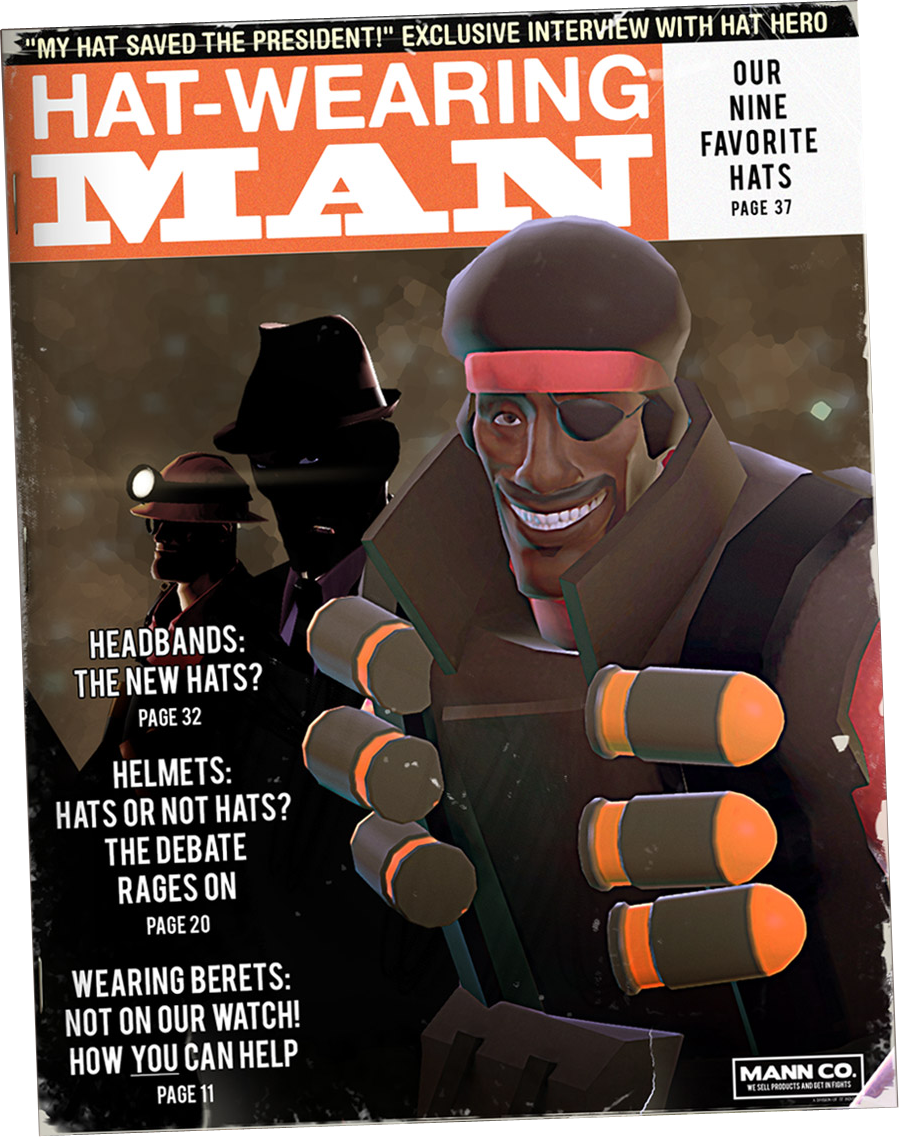
Developers, players, the ever closing gap between them… and hats.

In the old days, the world of video games was an ever so simple place. The Games Developers, Games Designers and Games Artists made the games whilst we, the consumers bought and played them. The growing influence of the Internet in the 1990’s started to change this traditional pattern, and creating mods of existing games became popular among PC gamers. For example Counter-Strike is one of the most popular shooters in the history of online gaming, yet it started life as a modification for Half-Life. It went on to spawn numerous other incarnations including Counter Strike: Source and has sold very successfully since its release in 2004.

So, we’ve established that it’s possible for modders to use existing engines to produce extremely successful games. Unfortunately, not everyone has the time or indeed the know how needed to build games (Naturally, a Train2Game course can help you work around these barriers.) However, now in 2010, it’s never been easier for a budding Games Designer, Games Developer or Games Artist to get involved with the production of a big name title, and Team Fortress 2 is the best example of this.

“Why is that?” I hear you ask. Well, the guys at Valve are extremely keen for the Team Fortress 2 community to get involved with the ongoing development of the game – for those unfamiliar with TF2 it has received free rolling updates since its release at the end of 2007. Hats for the in-game characters were introduced in 2009, and in March this year, Valve asked players to contribute their own ideas for in-game items. They received a massive response and shortly afterwards several budding designers were rewarded by seeing their work (re: mostly designs for hats) become part of official Team Fortress 2 universe. A second round of community updates has been applied today too!

So now you might be saying “Hats are silly, why do people care so much about them?” Well they don’t want them to give them an in game advantage that’s for sure; the hats are purely there for aesthetic reasons. But these comic creations allow players to add an aspect of individuality to themselves in-game and as a result are highly desired. The community I play with probably talk about hats as much as they do about the actual game they’re playing in!

With these hats being regarded so highly, the lucky few people who’ve had their designs adopted officially by Valve for Team Fortress 2 will have been seen – and perhaps fetchingly sported – by millions of players.

One TF2 fan called Mister Royzo has gone so far as to release his own (for now) unofficial update containing new skins for a number of the current in-game hats and weapons.  So as of yet, these aren’t hats in their own right but just replace others. BUT apparently Valve have taken a liking to what they’ve seen, so is it possible we could soon end up with the first fan-made official Team Fortress 2 update? Possibly…after all with Valve (hopefully!) soon to be releasing the long awaited Engineer update, all of the games nine classes will have been covered so perhaps fans will be invited to submit their own suggestions for entire updates.

If this does indeed happen, the gap between developers and players will be even further reduced and there arguably will have never been a better time anyone, including T2G students, to get their first big break in the industry.