
Almost 70% of internet users play casual games

Train2Game Games Survey blog image

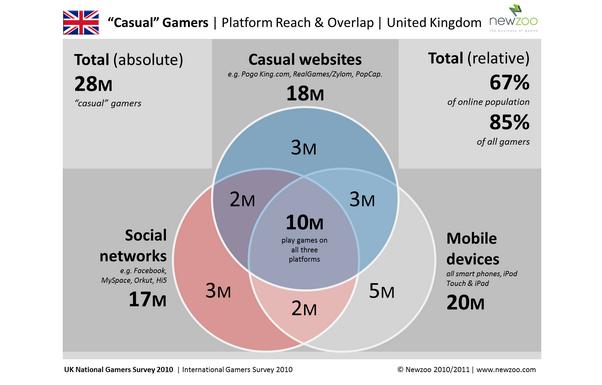
Almost 70% of the UK’s online population now use the internet or mobile phones to play games. The good news for Train2Game students – who may look to develop casual games in future – comes from the Newzoo National Gamers Survey 2010 of US and key EU markets.

The number of people playing on social networks, mobile devices or dedicated casual game websites has grown to 67% of the online population in the US and UK.The report says:

On average, online casual game destinations, such as RealGames/Zylom, King.com and PopCap.com reach two-thirds of this audience. As these players extend their games offering to social networks and mobile devices, they find themselves servicing the majority of the nations’ online population and 73% (Germany) to 88% (US) of all gamers. Overlap between platforms is considerable, illustrated by the fact that 46 million Americans – or 33% of all casual gamers – play games on all three platforms.
Graphs on US, UK, Germany, France, Netherlands and Belgium are available at www.newzoo.com

Peter Warman, Newzoo MD adds

It is clear from our data that there is no such thing as “the typical casual gamer”, as almost everyone plays a casual game at least now and again, including people playing World of Warcraft or Call of Duty Black Ops. As games become a more integrated part of people’s lives, there is a place and time for every type of game, regardless of platform”.

The Newzoo survey comes less than a month after the Social Gaming Smart Pack from Econsultancy revealed one fifth of all consumers play social media games. You can read about the report here on the Train2Game blog.

With more and more reports suggesting social media and casual gaming is on the rise, a small team of Train2Game students who produce a good game could potentially find that takes off thanks to how relatively simple it now is to distribute a product online.

The massive success of casual game Angry Birds has seen merchandise based on the game appear in stores around the world. While the ever increasing recognition of social media gaming has seen it become part of BAFTA. (See the Thoughts of Train2Game blog for more information)

So Train2Game, what are your thoughts on yet another survey reporting an increase in casual gaming? Are you starting to think this might be a market you want to develop games for? And how big do you think it can get?

As usual, you can leave your thoughts here on the Train2Game blog, or on the Train2Game forum. Alternatively leave us a comment on the Train2Game Twitter.

[Source: Newzoo]

Train2Game, in association with DR Studios and the University of Bedfordshire, will be holding a Game Jam at the end of March. For more information, see this Train2Game blog post or the Train2Game Game Jam Facebook page. Alternatively, keep an eye on the Train2Game Game Jam Twitter account.


Star Wars: The Old Republic ‘can be profitable with 500,000 subscribers’

Star Wars The Old Republic Train2Game blog image

EA claim their upcoming MMO Star Wars: The Old Republic will be profitable with 500,000 monthly subscribers.  That’s according to Electronic Arts CEO John Riccitiello who was speaking in a conference call.

“At half a million subscribers, the game is substantially profitable, but it’s not the kind of thing we would write home about. Anything north of a million subscribers, it’s a very profitable business.”

Riccitiello said the publisher is “incurring significant development costs” for Star Wars: The Old Republic, but suggested those costs would “”essentially turn on a dime” to profits when the game is released.

There is no official word from EA about a release date for Star Wars: The Old Republic, but a report from MCV Online suggests it’ll be available worldwide from September this year. However, increasing rumours of delays could mean it isn’t released until March 2012.

Riccitiello also criticised some games industry news outlets for ‘irresponsible reporting’ of the games development costs.

There’s been a fair amount of talk on various blogs describing [Old Republic development] spends that are vastly higher than anything we’ve ever put in place,” he said.

“Don’t read gamer blogs as having any substance. They bring a chuckle, but they also bring a frustration for those that are being responsible with the management of EA’s R&D dollars.”

For more information about Star Wars: The Old Republic see this post on the Train2Game blog, and this one on the Thoughts of Train2Game blog.

So Train2Game, what are your thoughts on Star Wars: The Old Republic? Do you believe it’ll be a successful MMO? Will you subscribe? Or do you think the competition from World of Warcraft – with its 12 million subscribers – is just too strong?

As usual, you can leave your thoughts here on the Train2Game blog, or on the Train2Game forum. Alternatively, let us know what you think through the Train2Game Twitter account.

[Souce: Gamasutra]

Train2Game, in association with DR Studios and the University of Bedfordshire, will be holding a Game Jam at the end of March. For more information, see this Train2Game blog post or the Train2Game Game Jam Facebook page. Alternatively, keep an eye on the Train2Game Game Jam Twitter account.

42% of all Kinect games sold made in UK

Developing motion controlled games may not be something Train2Game students have thought much about, but new figures say UK developers produce a significant number of these titles.

Figures from GFK Chart Track reveal that 42% of all Kinect games sold in the UK were also developed in Britain.  The best selling game for Kinect so far is Kinect Sports, developed by Warwickshire based studio Rare.  The game accounts for 28% of all KiNECT sales over the last ten weeks.

UK Game Developers now also hold a significant share of the PlayStation Move games sold, with 30% of software sales coming from software produced by studios here.

The FIGURES come from UKIE’s Motion Controller Report which looks at sales of Kinect, PlayStation Move and Wii Motion Plus games since October 2010.

“The array of strong products that our home-grown, UK talent is producing is something we can all be proud of.” said UKIE Chairman Michael Rawlinson

“This just shows how our UK developer base remains one of the best in the world, and can continue to step up to the plate as the market develops and platforms evolve.”

UKIE also point out that the current best selling game in the UK – as reported by the Train2Game blog – is LittleBigPlanet 2 from Guildford based studio Media Molecule.

Train2Game blog readers will know that the Kinect has sold extremely well.

So Train2Game, what are your thoughts on these sales figures? Had you considered developing motion controller based games before? Will you think about it now?

As usual, you can leave your thoughts here on the Train2Game blog, or on the Train2Game forum.

[Source:  CVG]

Report: Modern Warfare 3 being developed by three studios

Modern Warfare Train2Game blog image

Rumours that Call of Duty: Modern Warfare 3 is in production is bound to cause a stir with a number of Train2Game students. And if the LA Times is to believed, the game is in development with no less than three studios aiding in its production.

Activision has called upon Infinity Ward, Sledgehammer Games and Raven Software to work on the next title. No official announcement has been made about Call of Duty: Modern Warfare 3 but the LA Times alleges the information comes from inside sources.

Treyarch produced Black Ops, the most recent game in the Call of Duty series.  Sledgehammer, founded by ex-EA developers Glen Schofield and Michael Condrey has apparently postponed its own Call of Duty ‘spin off’ title to work on Activisions’ next project.  Raven are also said to have delayed one of their own projects to work on the multiplayer section of what is apparently going to be Call of Duty: Modern Warfare 3.

It’s a new move from Activision who’ve traditionally left Infinity Ward to develop the Call of Duty: Modern Warfare series without the help of others.

It’ll also be the first Modern Warfare game produced since the high profile departures of Game Developers f Jason West and Vince Zampella who then set up their own studio under the banner of Respawn Entertainment.

If the project truly is Call of Duty: Modern Warfare 3, the extra reinforcements could spark speculation whether the game will be ready or not in time for Christmas. This year it was Call of Duty: Black Ops which claimed the UK Christmas Number one

So Train2Game, if Call of Duty: Modern Warfare 3 is in development, are you interested in it at all? Do you think three studios working on the same project will have any outcome on the project? Do you think this is a bad sign for Activision?

As usual, you can leave your thoughts here on the Train2Game blog, or on the Train2Game forum.

David Braben’s tiny PC could revive the age of bedroom coding

Every Train2Game student is bound to be interested in this! A Tiny PC that costs a maximum of £15 has been revealed, and its creators hope the ultra portable computer – with the width of just a 20p coin – can encourage a new generation of game developers.

The Raspberry Pi has been called the spiritual successor to the BBC Micro of the 1980s, the computer that took many bedroom coders to high profile figures in the UK video games industry. Some Train2Game students probably grew up with them too!

The project was announced by Chairman of Frontier Developments David Braben  at the Learning Without Frontiers event (Which Train2Game Course Director Tony Bickley also attended ) and he has spoken to GamesIndustry.biz about it.   He hopes the Raspberry Pi it’ll encourage children to learn more about how computers actually work, and potentially turn them into the game developers of the future:

“A group of us formed a charity here in Cambridge called Raspberry Pi, with a view to creating the spiritual successor of the BBC Micro, to provide a way to motivate people to realise that computer science, maths, STEM subjects actually are not deathly dull – because that is the message a lot of kids seem to have picked up,” said Braben.

He also explained to GamesIndustry.biz what exactly the Raspberry Pi is:

“We’ve come up with a design and made early prototypes of a machine which is really, really small and allows people who don’t have access to a PC at home – which is true of a lot of kids – but do have a TV to have a device where they can browse the web, do email, YouTube, watch video very easily and cheaply.”

The result is a tiny self contained computer which can be directly plugged into the HDMI port and outputs an image of 1080p.  Each Raspberry Pi will also apparently be encased in material that will make it “indestructible”

Braben also told GamesIndustry.biz that the Raspberry Pi will be able to support various types of programming language:

“It can have some very simple scripting language programming – which might even be something like BASIC – so even though it doesn’t satisfy the gamut of all the objective oriented learning and so on, that’s very easy to pick up once you’ve got the general principals of how a computer works, what it does, how it does it”.

And the man behind the classic Elite hopes the Raspberry Pi will provide opportunities for a new generation of bedroom developers.

“It’s really trying to redress the balance a bit so kids coming up now do have at least a chance, and hopefully it’ll be someone like me ranting on in 20, 30 years about how that was a great opportunity for them. You never know!”

This newly announced device is sure to be of much interest to Train2Game students, especially those on the Game Development course.  The projects main aim is to make learning skills that are vital to the games industry both simpler and more enjoyable for kids. Of course, the Train2Game courses also allow adults to do this too, but the Raspberry Pi is sure to be good for the future of the games industry.

The announcement comes after Braben strongly criticised the teaching of ICT in the UK, and before the upcoming Livingstone-Hope review says there’s a growing skills gap in the UK game development industry. The Train2Game blog will be covering the launch of the report.

So Train2Game, what are your thoughts on David Braben’s Raspberry Pi? Do you think it will be helpful for the games industry? Would you spend £15 on one and do your own bedroom coding?

As usual, you can leave your thoughts here on the Train2Game blog, or on the Train2Game forum.

[Source: GamesIndustry.biz]

Train2Game blog student interview #2: Game Developer Stuart Wragg

There are over 2000 students currently on Train2Game courses, and with so many out there we decided it’d be a great idea to chat to them. Oursecond mini interview is with Train2Game Development student Kevin Wragg (AKA Nova on the Train2Game Forum)

Hi Kevin, Why did you choose to study with Train2Game?

Train2Game student Kevin: The main reason I decided to take up a course withTrain2Game, was due to fact I was unable to do the same course at collage or university because of financial commitments.  Train2Game allowed me to study while I was still working and was therefore the only course that ticked all the boxes.

Train2Game blog: Which Train2Game course did you decide to take and why?

Train2Game student Kevin: From a very young age I have always loved video games, but developing them never really struck me as a career path. It was only when I started running an online game for me and some friends, writing NPC scripts, adding new items and interfaces, that that I realised I loved it and wanted to learn more. So it was a little surprise when one day at work during my lunch break, I opened the paper to find an article on the games industry with a link to the Train2Game website. I promptly ripped the article from the paper, the rest as they say, is history!

Train2Game blog: What were you doing before you started your Train2Game course?

Train2Game student Kevin: Before I got interested in game development my life lacked any direction. When I left school I had no idea what I wanted to do, and ended up building boilers in a factory, which I’m still doing to this day. Before Train2Game I was a very ambitious person with no ambitions, now I feel like I have a direction in life.

Train2Game blog: How are you finding balancing the course with the rest of your life?

Train2Game student Kevin: Due to the nature of my job I often find myself tired after work, so most of the work I do for the course is at the weekends.  Its one aspect of this course that enables the course to fit around me rather than the other way around.  Another bonus is that during holidays I can put more work into it while I have the free time.

Train2Game blog:  What has been your favourite part of the course so far?

Train2Game student Kevin: It was great to meet Dave Sharp from Train2Game and the other students at the Newcastle meet, and I find the Train2Game forum a great place to meet like minded people all working towards the same goal.  I think the best is yet to come, but I’ve thoroughly enjoyed what I have learnt so far and I’m eager to get stuck into the rest of the course.

Kevin is on the Train2Game Game Development course


Train2Game blog student interview #1: Lauren Black

There are over 2000 students currently on Train2Game courses, and with so many out there we decided it’d be a great idea to chat to them. Our first mini interview is with Train2Game Development student Lauren Black. Subjects she talks about include why she chose Train2Game, what was she doing before and her favourite part of the course so far.

Train2Game Blog: Hi Lauren, why did you choose to study with Train2Game?

Train2Game student Lauren: Since leaving school I’ve had quite a problem with studying in an academic environment. I had tried college, with the ultimate aim of going for a degree three times, and I’ve always felt like the tutors don’t know the subject they’re teaching well enough.

I even had one tutor who didn’t know the difference between Java and JavaScript, and for a web development module that would be quite an imperative titbit. With this being the case, I felt like I wasn’t learning anything, so why continue? I found out about the course when I was moving house – I found one of those little blue leaflets on my new doormat, and I took that as a good omen. A new house and a new direction, it couldn’t hurt to give it a go!

Train2Game Blog: Which Train2Game course did you decide to take and why?

Train2Game student Lauren: I’ve always been a bit of a geeky chick, and because of my history in web development I chose the Game Development course. For a couple of years I’ve wanted to break into the gaming industry so that I could both do something interesting with my skills, and also gain the knowledge and expertise to expand my businesses.

Most of my expertise lies in PHP development and since the course seemed to cover C++ in quite some depth, I figured that it would be beneficial to learn, not only to be applied to games, but to other performance-critical applications relevant to my clients.

Right now I’m having so much fun doing the course, hearing the ‘thunk’ of the book hit the floor in the post has become the highlight of my week!

Train2Game blog: What were you doing before you started your Train2Game course?

Train2Game student Lauren: Before starting the course, I had mostly been working on a freelance basis. I currently own and run an IT business, which deals primarily with web application development.

Prior to hearing about the course, I knew I needed to gain more skills; specifically I needed to learn C++. What most people don’t realise is that games, no matter how trivial they may seem, are a result of very sophisticated pieces of performance optimised software, making thousands of independent calculations every second.

The Train2Game Development course seemed like the perfect compliment to the direction I was already taking, and is allowing me to continue my career.

Train2Game blog: How are you finding balancing the course with the rest of your life?

Train2Game student Lauren: The course itself is very easy to keep on top of, each new chunk of information is provided in bite-size sections. I may be a little more experienced than the average student, but generally it takes me about an hour to read through each section followed by the tutor marked assignment I usually take around lunchtime. It’s the sort of thing that can easily be done in the evenings, or spread over a number of days.

Given my academic history, it’s great because I can take the course at my own speed without feeling patronised by incompetent tutors. Actually, speaking of tutors, twice I’ve called the tutor team to ask fairly complicated questions – and both times I really felt like I was speaking to someone of my own level, who actually knew what they were talking about. Definitely not someone in a call centre reading from a script!

Train2Game blog: What has been your favourite part of the course so far?

Train2Game student Lauren: Currently I’m about half way through Section 2. I’m just in the middle of developing a simple 2D game engine to build a platform game on top of.

Whilst it’s true the code given (at least at this stage) has been simplified, it clearly illustrates each integral part, so as a little side project I’m now able to expand upon the lessons learned by studying the engine provided to create my own cross platform version that will run on Windows, Linux and Apple machines and even iPhones.

Granted, these extras aren’t taught by the course, but it does go to show that the same fundamental lessons can be applied in many different circumstances.

Lauren is on the Train2Game Game Development course.

Deus Ex: Human Revolution delayed

Deus Ex: Human Revolution Train2Game blog image

Square Enix has announced that Deus Ex: Human Revolution will be delayed in news that will come as a disappointed to fans of the series on the Train2Game forum.

The game was scheduled for release in the first quarter of 2011, but has now been pushed back to the second part of the financial year which begins in April.

If any Train2Game students reading are confused by the language just used, it’s because the Deux Ex: Human Revolution delay came in a Square Enix announcement to investors! Interestingly, the language used in the note to investors seems to suggest the poor performance of Final Fantasy XIV is implied as one of the reasons for the delay:

“With weak sales performance of console game titles that have been newly released during the current fiscal year as well as harsh market feedback regarding a key title, the Group recognizes the reinforcement of development capability in our Digital Entertainment segment as our most critical managerial issue,”

“We therefore have decided to spend additional time to further polish our upcoming game, Deus Ex: Human Revolution, resulting in a shift in release timing from our prior plan of the current fiscal year to next fiscal year.”

So at least there’s one positive for disappointed Train2Game students, Deus Ex: Human Revolution will get to spend more time with the Game Designers, Game Developers and Game Artists behind it and hopefully it’ll be better game because of it.

For now, Train2Game students can console themselves by watching the first, or second Deus Ex: Human Revolution trailer on the Thoughts of Train2Game blog. You can look at the Thoughts of Train2Game blog to see what bonuses the special ‘Augmented Edition’ of Deus Ex: Human Revolution will provide.

Deus Ex: Human Revolution is being developed by Eidos Montreal and will be available on PlayStation 3, Xbox 360 and PC…well, some time from April 2011 onwards.

So Train2Game,  are you disappointed by the delay? Or are you happy to see Deus Ex: Human Revolution spend more time in development? Do you find it strange how the failure of another game is causing this to be delayed?

As usual, you can leave your thoughts here on the Train2Game blog, or on the Train2Game forum.

[Source: Eurogamer]

“If you’re having no fun making your game then you’re in trouble” says Joe Danger creator

Joe Danger Train2GameTrain2Game students are no doubt enthusiastic about their games design, developer and artist and animator courses, but Hello Games boss Sean Murray says developers in the industry should be more enthusiastic about the work they produce.

Speaking at the Evolve in London conference, Murray said:

“Some game developers, they don’t play their own games, they don’t feel it’s an expression of themselves think that’s very sad.”

“I think some of the gameplay mechanics that are in the social gaming space are more indicative of that, there are certain pyramid scheme elements to the game design that I don’t think anyone who just wanted to make a game that they themselves would play would ever put that in.”

“The social games of the future that are just built around rewards and pyramid schemes… maybe don’t have as much a place in that world”

During his talk, the Hello Games boss showed videos of Joe Danger developers laughing and having fun while playtesting the game.  He said that “If you’re having no fun making your game then you’re in trouble,” We’d therefore very much like to think that Train2Game students are having fun when they’re developing games!

Murray also spoke about how motion controllers saying that they’re great in theory, but “”inaccurate motion control actually reduces interactivity and that’s harmful” He then showed the video of someone ‘playing’ Kinect Joyride and coming third despite not moving at all during the race.

“It’s such as shame, it’s such a lost opportunity. It is actually a good game, but there’s a danger of making games too casual and removing interactivity, and you see that sometimes. I think even the casual gamer doesn’t want to just have reward.” He said.

Train2Game have a great opportunity to be enthusiastic about producing games through entering the Train2Game Christmas Competition. The winners will see their game published during 2011!

So Train2Game, what are your thoughts on Sean Murray’s comments?  Do you think he’s right about social games? And how enthusiastic are you about your Train2Game projects?

As usual, you can leave your thoughts here on the Train2Game blog, or on the Train2Game forum.

(Source: GI.biz)

This Dragon Age 2 developer diary is a must watch for Train2Game students!

Dragon Age 2 Train2Game

Bioware has released a developer diary for Dragon Age 2 which should prove of interest to Train2Game students be they a games developer, games designer or games artist and animator, because it almost contains everything!

The developer diary not only features Executive Producer Mark Darrah, Art Director Matthew Goldman and Lead Designer Mike Laidlaw talking about the concepts and ideas behind Dragon Age 2, but it also features gameplay, concept models and even some nice looking animated videos. Train2Game artists will be especially interested in the latter!

The Dragon Age 2 developer diary begins with Executive Producer Mike Darrah stating that meetings about the game had begun in 2009 before Dragon Age: Origins had even been released.  This cumulated in an impressive looking animated first build which the team say contains many of the elements that feature in the opening of Dragon Age 2.

The developers also say that there were ideas they had in these opening stages that in the end didn’t make the cut. For example, Art Director Matthew Goldman says he wanted protagonist Hawke to be a he lycanthrope that tasted his own blood and howled like a werewolf. Obviously, this idea hasn’t made it into Dragon Age 2!

The idea of cutting out more outlandish concepts from a game is something that games industry consultant Nicholas Lovell discussed during an interview with Train2Game.

Lead Designer Mike Laidlaw also talks us through one of the main changes for Dragon Age 2, where choices the player makes will have affects right away, rather than at the end of the game:

“Where Origins really shone by having this huge epilogue with thousands of variations based on the choices you made, we’ve instead moved that into the gameplay.”

“People you have interacted with at the beginning of the game are going to have their situations profoundly affected by their interactions with Hawke – your character. You re-interact with them. You see how that worked out. So we believe [this] be our most interactive game to date.”

The team also discuss how they’re aware that some of the changes they’ve made are big, but they believe that it will change Dragon Age 2 for the better.

Interested Train2Game students can watch the Dragon Age 2 developer diary below, courtesy of GameSpot UK.

If that isn’t enough Dragon Age 2 action for you Train2Game, you can check out the extended trailer in this Train2Game blog post from August.

Long time Train2Game blog readers will know that we’ve previously been massive advocates of Dragon Age: Origins, even going so far as to say that it’s a game that all Train2Game students should appreciate. The sheer open nature of the game means that the game designers needed to put a lot of effort into writing the different outcomes, while game developers and game artist and animators would have worked on parts of the game that the majority of players may not have even seen!

Dragon Age: Origins also ended up with a lot of game mods, and as Train2Game students will know modding can provide great practice when it comes to using your skills. Perhaps Dragon Age 2 will come with the same opportunities.

Dragon Age 2 is scheduled for release for PlayStation 3, Xbox 360 and PC on March 11th 2011.

So Train2Game, what are your thoughts on the Dragon Age 2 developer diary? Does it provide you with a good insight into how producing a game as massive as Dragon Age 2 works? And what do you think about the changes that have been made to the game since Origins? Has the game perhaps been tailored to a console audience?

You can leave your thoughts here on the Train2Game blog, or on the Train2Game forum.