Digital distribution – The Train2Game students best friend?

Digital and pre-owned games constituted one third of the United States market last year, with US consumers spending over $4.5 billion dollars on them according to research by the NPD Group.

It wasn’t so long ago that discs, or cartridges, were the only way for the consumer to purchase a video game. But thanks to the wonders of the internet, it’s now so easy to buy games without even leaving the house.

Of course, there’s the standard online shopping which allows consumers to buy the latest Call of Duty or FIFA through just a few clicks, but even then they’ll have to wait a few days for the postman to deliver what they want. So the gamer might be happy about not having to leave the house – because let’s face it, if we can avoid moving we will – but less pleased about not instantly receiving the game.

Digital downloads almost entirely bypass this issue. When purchasing a game, then downloading it, the consumer doesn’t have to wait long at all before they can play it. Of course, Train2Game has previously examined the discs vs. digital debate, but over the weekend I saw for myself just how easy it is for us download games – games that we may have had no intention of actually buying in the first place!

I like to relax – if relaxing can be defined as bellowing instructions to teammates down a microphone – by playing Team Fortress 2. Now, in order to play Team Fortress 2 I need to log into Steam, Valve’s content delivery system. When I logged in, a special offer popped up saying the Mass Effect games were on offer over the weekend only, with a whopping 75% off the RRP. Having never played a Mass Effect game, and having heard how great they are, I decided to buy the first Mass Effect title for the grand total of £3.24. If I could have afforded to, I would have bought Mass Effect 2 for £12.99 too.

So, having signed into Steam to play Team Fortress 2, I find that I’ve parted with my hard earned cash and soon have a shiny digital copy of Mass Effect installed on my hard drive.

This is why digital downloads are ever-increasing their share of the consumer games market – it’s just so easy to download a game! The thought of buying Mass Effect hadn’t even crossed my mind before I logged into Steam on Sunday afternoon, but a few hours later the game had been added to my collection.

Of course, the knock down price played a massive part in my decision to make the purchase – which is probably why pre-owned games are doing so well too – but the fact is I parted with my cash and bought a game that is two years old through digital distribution.

Train2Game students should take heed of how powerful the digital market has become in recent years, and strive to take advantage of it. A Games Developer, Games Designer and Games Artist & Animator can get together and make a game yes, but ultimately in order to become successful in the industry their creations will have to sell. For Train2Game graduates just starting out in the industry, digital distribution would be by far the easiest way to do this, be it through a standard PC download, Steam, the PlayStation Network or Xbox Live.

There’s a consumer market out there, who with the right incentives will buy new games at the drop of a hat. What will you do to market yours? As usual, freel free to leave your comments here or on the Train2Game forum.
Sony E3 Press Conference – The key announcements

Like  Microsoft’s presentation before it, Sony’s press conference not only saw key titles get release dates, but also full details on their own motion controller – the PlayStation Move.

In surprising – but welcome on this side of the Atlantic – twist, the PlayStation Move will be available in Europe on September 15th this year, four days before it’s released in the United States. The motion controller and PlayStation eye will be available in a bundle for €59.99 – a price in pounds sterling is yet to be revealed, but it’ll be much lower in cost than Microsoft’s Kinect.

Speaking at the E3 press conference, Sony President and CEO of Sony Computer Entertainment of America Jack Tretton, added that 40 developers are currently working on Move titles. Hopefully some of these will be innovative games, and the type that Train2Game students – be they a Games Designer, Games Developer, or Games Artist & Animator – would be proud to work on.

In non-Move related news, several of the PlayStation 3’s flag ship titles we’re given release dates including the long awaited – and long delayed lest we forget! – Gran Turismo 5. The racer will be available in the USA from Novemer 2nd with a trailer revealing the Top Gear test track as one of the circuits. Jack Tretton also revealed that the game will be fully 3D compatible.

In other PlayStation 3 games news, Killzone 3 will be released in February 2011 – slightly earlier than thought, while it was announced there will be PS3 exclusive content for Assassin’s Creed’s Brotherhood, Medal of Honour and Dead Space 2. There were also new details about the much anticipated Little Big Planet 2.

However, perhaps the biggest surprise of the show so far, was that Valve’s Gabe Newell himself appeared on stage to announce that Portal 2 will be coming to the PlayStation 3. It’ll be connected to Valve’s powerful Steamworks service with the PlayStation 3 being the only system doing so. It represents a huge turnaround for Gabe Newell – previously one of Sony’s consoles biggest critics. While on stage he joked “I’d like to thank everyone at Sony for their hospitality and not repeatedly punching me in the face.”

So, that’s a quick round up of Sony’s E3 Press Conference? Are you impressed? If so what are you looking forward to? As usual, leave your comments here or on the Train2Game forum.

Real money or digital currency?

With online gaming becoming an evermore-prevalent cornerstone of the games market, many developers are also turning to the Internet for publishing. As mentioned previously in this blog it’s Valve and their online digital distribution service Steam that are the current masters of this art – you pay your money you get your game.

Now many other developers are seriously looking at the prospect of online only publishing and this includes Realtime Worlds, the developer behind Crackdown and APB. The latter is an action orientated MMO which when purchased comes with 50 free hours of online play. After this, 20 more hours can be bought for £5.59 or if the player prefers they can buy a 30 day unlimited package for £7.99.

It’ll also be possible to buy this extra play time using an in game currency, RTW points, which can be bought in large amounts with real money or made through selling custom items to other players. In an interview with Develop, APB Lead Designer EJ Moreland said it’s a system that’ll also be implemented in the developers’ future titles.

““Realtime Worlds is transitioning from being a developer to being an online publisher, [and] RTW Points is going to be the currency for all of our games in the future.”

One of those games is a yet unannounced title and Moreland’s comments seem to suggest that the Dundee-based studio will be producing another online title.  Of course, through self-publishing a title online the Games Developers, Games Designers, and Games Artists cut out the middle man in the form of needing to cover the costs of physical discs and retail. This may very well be appealing to Train2Game students looking to break into the market.

However, one has to wonder if people will use the currency to buy extra playtime. Paying for RTW points with a debit card will take some time, then will the whole process have to be repeated in order to pay for the actual product? Though perhaps the use of RTW points will strengthen the APB community, and ultimately encourage them to play for longer – and thus pay for more content. Maybe players with large amounts of RTW points will play future titles too, seeing as they’ve already stocked up on the currency needed to buy it. We’ll see.

What do you think is the best system for a developer to use when publishing a game online? Real money or a specific type of in-game currency?

Developers, players, the ever closing gap between them… and hats.

In the old days, the world of video games was an ever so simple place. The Games Developers, Games Designers and Games Artists made the games whilst we, the consumers bought and played them. The growing influence of the Internet in the 1990’s started to change this traditional pattern, and creating mods of existing games became popular among PC gamers. For example Counter-Strike is one of the most popular shooters in the history of online gaming, yet it started life as a modification for Half-Life. It went on to spawn numerous other incarnations including Counter Strike: Source and has sold very successfully since its release in 2004.

So, we’ve established that it’s possible for modders to use existing engines to produce extremely successful games. Unfortunately, not everyone has the time or indeed the know how needed to build games (Naturally, a Train2Game course can help you work around these barriers.) However, now in 2010, it’s never been easier for a budding Games Designer, Games Developer or Games Artist to get involved with the production of a big name title, and Team Fortress 2 is the best example of this.

“Why is that?” I hear you ask. Well, the guys at Valve are extremely keen for the Team Fortress 2 community to get involved with the ongoing development of the game – for those unfamiliar with TF2 it has received free rolling updates since its release at the end of 2007. Hats for the in-game characters were introduced in 2009, and in March this year, Valve asked players to contribute their own ideas for in-game items. They received a massive response and shortly afterwards several budding designers were rewarded by seeing their work (re: mostly designs for hats) become part of official Team Fortress 2 universe. A second round of community updates has been applied today too!

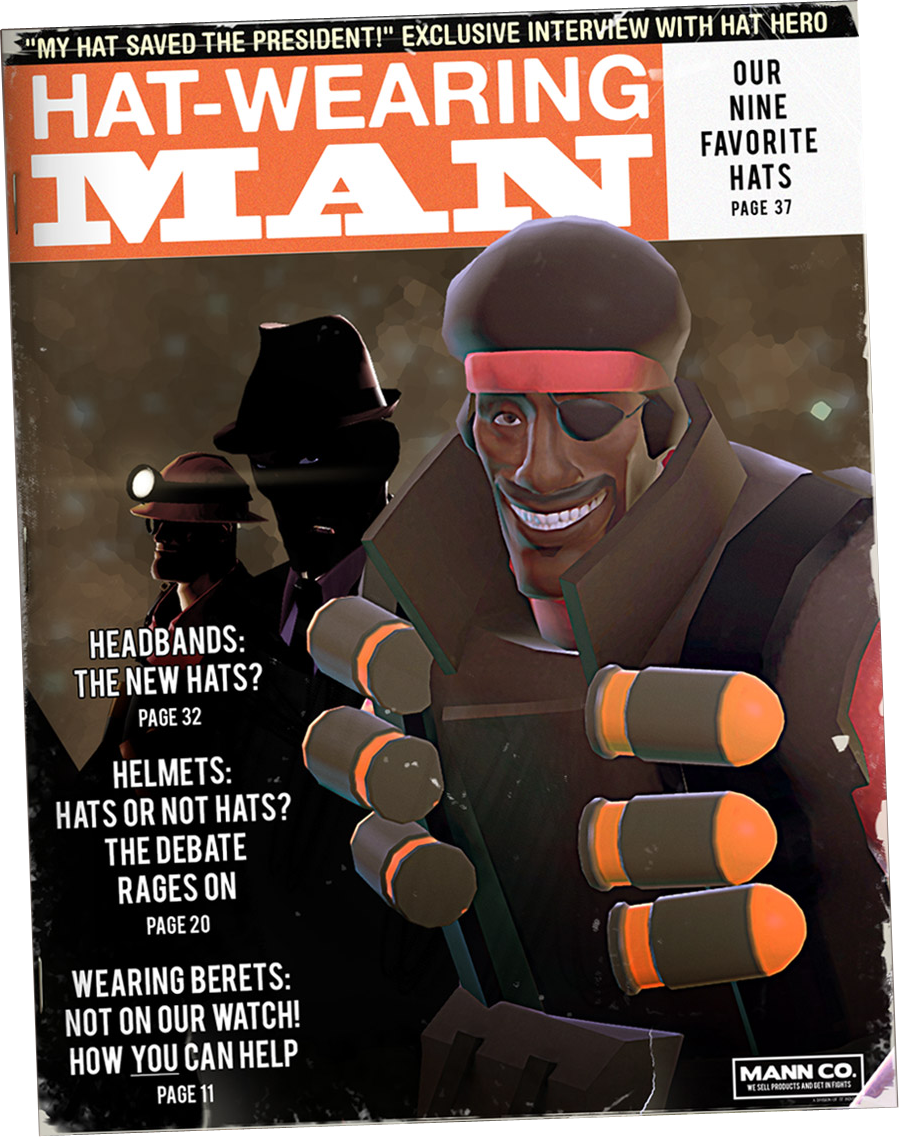
So now you might be saying “Hats are silly, why do people care so much about them?” Well they don’t want them to give them an in game advantage that’s for sure; the hats are purely there for aesthetic reasons. But these comic creations allow players to add an aspect of individuality to themselves in-game and as a result are highly desired. The community I play with probably talk about hats as much as they do about the actual game they’re playing in!

With these hats being regarded so highly, the lucky few people who’ve had their designs adopted officially by Valve for Team Fortress 2 will have been seen – and perhaps fetchingly sported – by millions of players.

One TF2 fan called Mister Royzo has gone so far as to release his own (for now) unofficial update containing new skins for a number of the current in-game hats and weapons.  So as of yet, these aren’t hats in their own right but just replace others. BUT apparently Valve have taken a liking to what they’ve seen, so is it possible we could soon end up with the first fan-made official Team Fortress 2 update? Possibly…after all with Valve (hopefully!) soon to be releasing the long awaited Engineer update, all of the games nine classes will have been covered so perhaps fans will be invited to submit their own suggestions for entire updates.

If this does indeed happen, the gap between developers and players will be even further reduced and there arguably will have never been a better time anyone, including T2G students, to get their first big break in the industry.

Welcome to Steam Mac users!

So, the date that Valve’s digital distribution service Steam will be released on Mac’s has finally been revealed. On May 12th, Apple users will finally be able to join PC gamer’s in spending countless hours not only playing classics such as Half Life 2, Portal and Team Fortress 2, but a wide variety of independent titles as well. (Perhaps one day Train2Game students will see their work released through Steam!)

So, what does the release of Steam on Apple systems actually mean? Well, firstly it’ll allow staunch Mac users – you probably know one…the ones that refuse to use Microsoft products – to play a wide variety of quality games. Now, I’m not a Mac user but some of my best friends are and on countless occasions I’ve had to hear them complain about either the lack of decent games available on Mac’s or the fact that they appear to be a lot more expensive than PC games. Hopefully the release of Steam on the Mac will leave these chaps with nice warm feeling in their tummies.

So, will the introduction of Steam onto Mac’s have any benefits for the traditional PC gamer? Well, if you only own a PC then probably not. But if you own say, both a PC and a MacBook, the digital distribution service means not only can you install your games on both systems, but it’ll also allow you to play on your PC then pick up where you left off on a Mac. It’s therefore probably a good thing that I don’t own a MacBook then…that’d cause another crippling addiction to Football Manager for sure.

Now, quickly moving on before I have a relapse:… Another that the introduction of Valve’s digital distribution service to a new system will have, is that Mac gamers will be able to play online along side their PC gaming counterparts. There won’t be any form of segregation, it’ll be Mac and PC owners living peacefully together  as they attempt to shoot each other in the virtual face. Sure, you might get the odd pro-Mac or anti-Microsoft spray in an online game,  but that’s hardly going to cause World War III. Or are some of you out there  that are really, really against including Mac users in your games?

So there you have it Mac users, you have just under two weeks to wait before you get to join the largest digital gaming community around. And PC gamers…make them feel welcome will you?