Games on discs still reign supreme

Discs remain the gamers top choice

80 to 90% of video games are still purchased on disc according to a report by the Entertainment Merchants Association. The D2 Report: Discs & Digital – The Business of Home Entertainment Retailing states that physical media such as DVDs, Blu-rays and other video game discs are remain the overwhelming choice of consumers.

This echo’s previous surveys that suggest despite the rise of digital distribution, especially on the PC thanks to Steam, we still prefer a physical copy of a game over one that’s been downloaded.

The report says combined DVD and Blu-ray Disc sales in the USA totalled $17.9 billion in 2009, nine times the revenue generated by digital distribution channels. 80 to 90% of games purchased were also through these traditional outlets. EMA president and CEO Bo Andersen says there’s a lot of life left in discs yet.

“While there has been a great deal of focus recently on the slippage of revenues in the DVD market, the untold story is that consumers’ embrace of home entertainment remains very strong and packaged media is the preferred delivery instrument”

“Digital distribution is clearly an important segment of the home entertainment market and will continue to grow in market share in the coming year. While it is tempting for industry outsiders to say ‘disc is dead,’ as the saying goes, reports of its demise are grossly exaggerated.”

While the EMA openly support entertainment retailers, the report used data together data from leading home video and video game industry analysts, including Adams Media Research, Digital Entertainment Group, The NPD Group, Parks Associates, and ScreenDigest.

The report also notes that transactions for ‘pre-recorded video content’ increased by 2.8% in 2009.

So Train2Game, what percentage of your games are on discs compared to being downloaded through digital distribution? Do you still think a game in a box is the ultimate form of distribution?

And what were the last games you bought through each method of purchase?

As usual, leave your thoughts here or on the Train2Game forum.
Valve offer free game after ban blunder

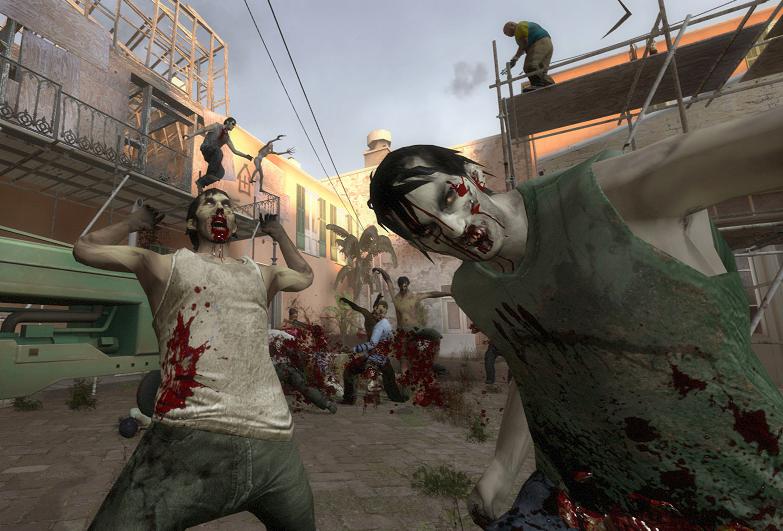
Nothing says "I'm sorry" like zombies.

Well that’s certainly one way to apologise. Valve has offered not one, but two, copies of Left 4 Dead 2 to the 12,000 players that were accidently banned from playing Call of Duty: Modern Warfare 2 via Steam.

Poor, innocent gamers found themselves banned from online servers and the internet was flooded with forum posts pleading for help. Alas, Valve support staff could only tell these poor gamers that they were unable to help. It looked like many wouldn’t be able to play Modern Warfare 2 on PC anymore.

However, each of these players can now get back to shooting each other again, and have the option to pick up two free copies of Left 4 Dead 2. So, now they can shoot zombies too.   Players affected by the ban received an e-mail from Valve CEO Gabe Newell which said:

“Recently, your Steam account was erroneously banned from Call of Duty: Modern Warfare 2.

This was our mistake, and I apologize for any frustration or angst it may have caused you.

The problem was that Steam would fail a signature check between the disk version of a DLL and a latent memory version. This was caused by a combination of conditions occurring while Steam was updating the disk image of a game. This wasn’t a game-specific mistake. Steam allows us to manage and reverse these erroneous bans (about 12,000 erroneous bans over two weeks).

We have reversed the ban, restoring your access to the game. In addition, we have given you a free copy of Left 4 Dead 2 to give as a gift on Steam, plus a free copy for yourself if you didn’t already own the game.”

Well isn’t that nice?  It’s not often you see a Games Developer Apologise for their mistakes? Do Train2Game students think that other developers – we won’t name specific examples of course – could learn a thing or two from Valve? And have you ever thought about what you’d do if there was a mistake in one of your games?

As usual, leave your thoughts here or on the Train2Game forums.

Digital distribution – The Train2Game students best friend?

Digital and pre-owned games constituted one third of the United States market last year, with US consumers spending over $4.5 billion dollars on them according to research by the NPD Group.

It wasn’t so long ago that discs, or cartridges, were the only way for the consumer to purchase a video game. But thanks to the wonders of the internet, it’s now so easy to buy games without even leaving the house.

Of course, there’s the standard online shopping which allows consumers to buy the latest Call of Duty or FIFA through just a few clicks, but even then they’ll have to wait a few days for the postman to deliver what they want. So the gamer might be happy about not having to leave the house – because let’s face it, if we can avoid moving we will – but less pleased about not instantly receiving the game.

Digital downloads almost entirely bypass this issue. When purchasing a game, then downloading it, the consumer doesn’t have to wait long at all before they can play it. Of course, Train2Game has previously examined the discs vs. digital debate, but over the weekend I saw for myself just how easy it is for us download games – games that we may have had no intention of actually buying in the first place!

I like to relax – if relaxing can be defined as bellowing instructions to teammates down a microphone – by playing Team Fortress 2. Now, in order to play Team Fortress 2 I need to log into Steam, Valve’s content delivery system. When I logged in, a special offer popped up saying the Mass Effect games were on offer over the weekend only, with a whopping 75% off the RRP. Having never played a Mass Effect game, and having heard how great they are, I decided to buy the first Mass Effect title for the grand total of £3.24. If I could have afforded to, I would have bought Mass Effect 2 for £12.99 too.

So, having signed into Steam to play Team Fortress 2, I find that I’ve parted with my hard earned cash and soon have a shiny digital copy of Mass Effect installed on my hard drive.

This is why digital downloads are ever-increasing their share of the consumer games market – it’s just so easy to download a game! The thought of buying Mass Effect hadn’t even crossed my mind before I logged into Steam on Sunday afternoon, but a few hours later the game had been added to my collection.

Of course, the knock down price played a massive part in my decision to make the purchase – which is probably why pre-owned games are doing so well too – but the fact is I parted with my cash and bought a game that is two years old through digital distribution.

Train2Game students should take heed of how powerful the digital market has become in recent years, and strive to take advantage of it. A Games Developer, Games Designer and Games Artist & Animator can get together and make a game yes, but ultimately in order to become successful in the industry their creations will have to sell. For Train2Game graduates just starting out in the industry, digital distribution would be by far the easiest way to do this, be it through a standard PC download, Steam, the PlayStation Network or Xbox Live.

There’s a consumer market out there, who with the right incentives will buy new games at the drop of a hat. What will you do to market yours? As usual, freel free to leave your comments here or on the Train2Game forum.

Discs vs Digital – Round 2

Another big name has waded into the Discs vs Digital debate in the form of Namco Bandai VP of sales, marketing and publishing Olivier Comte.

You may remember that recently, SCEE President Andrew House acknowledged that games sold on discs in boxes are still popular but that digital content could possibly the way forward. His comments were discussed in great detail on the Train2Game Forum.

In an interview with MCV, Comte spoke about a number of subjects including the digital market. He questioned its relevance on consoles;

Today digital is a significant part of PC gaming. We are a Japanese company and Japanese companies are not known for PC titles. But we need to have a product on every platform – including PC – so in that sense digital will start to become more important for Namco Bandai. There is better margin and using a digital platform gives us direct access to the consumer.”

“But in terms of console, it is a little bit too early to say. The only real business model for digital on consoles is DLC because the consumer will always want to have the box because it is an expensive thing.”

He raises a good point about the contrasts between the digital markets of console and PC games. As mentioned in a previous blog, the PC has embraced the idea of digital distribution and downloadable content far more enthusiastically than the Xbox 360 or PlayStation 3 has. The dominance of Steam in the digital distribution market has of course helped this along. Meanwhile, console owners prefer their games to some on a disc in a box.

So, while downloadable games may not be to the tastes of major distributors, it’s an ideal way for independent Games Designers, Games Developers, and Games Artists and Animators – like Train2Game students – to get their work out there.

This appears to have worked for independent studio Hello Games, who’ve just released their first production in form of Joe Danger on the PlayStation Network – and it’s had some very good reviews. We’ll have to wait and see if these positive reviews transform into downloads, but with a relatively low price it’s likely that many gamers will be tempted to try it out.

We’re not so willing to risk our money on something new if it costs £40 and doesn’t even come in a box. But this raises an important question for independent developers; do you save costs by releasing your first game as a digital download? Or do you sell it in a box which consumers can pick up on the shelf. Train2Game students, as producers, which medium would you prefer?

Discs vs Digital

Digital distribution of games might be becoming more popular, especially on PC, but according to Sony, “Disc based content is still very much what the consumer is used to and wants”

Speaking to the PlayStation blog about content delivery, SCEE President Andrew House acknowledged that while discs are still popular, improved technology is making digital downloads an increasingly attractive option.

“There has been a change in attitude and technology that is making digital delivery far more feasible and far more attractive. It is our job to ensure that consumers have the choice between the two where possible.

How this area will evolve, I can’t really say at this time, as we are relying on many things outside of our control, such as broadband speeds. Things are changing quickly and we have to make sure we are ready for those changes.”

So while discs remain the dominant force on consoles for now, it appears Sony will be keeping a close eye on how the ability to distribute digital content delivers in future. Indeed, only this week it was revealed that the PSP2 could be a download content only device.

However, at this moment in time it seems farfetched that a PlayStation 3 or an Xbox 360 could become completely download only. Industry analyst Michael Pachter even goes so far to say that there’s “No chance in hell” of this happening, and explained:

“PCs are probably about 95% connected to the internet but my guess is with the Xbox 360, it’s maybe two-thirds, with the PS3 it might be as high as 85%. And with the Wii my guess is it’s below 50% but probably closer to 35%, so it’s all the guys that are NOT connected that are going to keep games from ever being mandate downloadable.”

He raises a good point. Perhaps the PC market could become a fully digital industry at some point in future just due to the very nature of how a computer works. A brand new PC has a massive hard drive and this can easily be upgraded as time goes on in order to store more content. Consoles on the other hand have limited space. What would happen to a game that needed to be uninstalled to make room for a new one?

It’s this question that’s one of the main reasons that I personally prefer to buy my games on discs. I can access them any time I want just by picking them up off the shelf. It’d be an incredible hassle to constantly have to re-install older games I may want to go back to.

Of course, both the PlayStation Store and Xbox Live allow you to download smaller independent games – one a Train2Game student could develop – but even this can take a long time. It could therefore take most of a day to download and install, say a digital version of Red Dead Redemption onto a console.

Yes, I occasionally use digital distribution through Steam to download PC games, but at the end of the day, I still prefer to have physical copies available on my shelf not only for me to pick up and play whenever I want to, but also just to sit there and look nice in exactly the same way books or DVD’s would.

Digital distribution does have advantages, a cheaper price for the consumer and an easier way for an aspiring Games Developer, Games Designer or Games Artist to get their work out to the market. But personally, I believe that discs will be around for a long time yet.

How about you? Do you prefer to buy games as a physical disc in your hand? Or as a digital download? How do you think this will develop in future?

Real money or digital currency?

With online gaming becoming an evermore-prevalent cornerstone of the games market, many developers are also turning to the Internet for publishing. As mentioned previously in this blog it’s Valve and their online digital distribution service Steam that are the current masters of this art – you pay your money you get your game.

Now many other developers are seriously looking at the prospect of online only publishing and this includes Realtime Worlds, the developer behind Crackdown and APB. The latter is an action orientated MMO which when purchased comes with 50 free hours of online play. After this, 20 more hours can be bought for £5.59 or if the player prefers they can buy a 30 day unlimited package for £7.99.

It’ll also be possible to buy this extra play time using an in game currency, RTW points, which can be bought in large amounts with real money or made through selling custom items to other players. In an interview with Develop, APB Lead Designer EJ Moreland said it’s a system that’ll also be implemented in the developers’ future titles.

““Realtime Worlds is transitioning from being a developer to being an online publisher, [and] RTW Points is going to be the currency for all of our games in the future.”

One of those games is a yet unannounced title and Moreland’s comments seem to suggest that the Dundee-based studio will be producing another online title.  Of course, through self-publishing a title online the Games Developers, Games Designers, and Games Artists cut out the middle man in the form of needing to cover the costs of physical discs and retail. This may very well be appealing to Train2Game students looking to break into the market.

However, one has to wonder if people will use the currency to buy extra playtime. Paying for RTW points with a debit card will take some time, then will the whole process have to be repeated in order to pay for the actual product? Though perhaps the use of RTW points will strengthen the APB community, and ultimately encourage them to play for longer – and thus pay for more content. Maybe players with large amounts of RTW points will play future titles too, seeing as they’ve already stocked up on the currency needed to buy it. We’ll see.

What do you think is the best system for a developer to use when publishing a game online? Real money or a specific type of in-game currency?

Are indie developers leading the way when it comes to combating piracy?

Gaming is an expensive pastime and almost always has been.  One of the first commercially available 3D release was Virtua Racing, which may have looked awful by today’s standards but in 1994 it was the height of technology and cost almost £50. Nowadays, if you look in the right places, you can pick up new releases for around £35, although some games will still get you back over £50 – Call of Duty: Black Ops has apparently got an RRP of £54.99.

Of course, there are those among us who don’t pay for games… the pirates but not ones with eye patches and swords, oh no, but the people who download brand new games illegally without paying for them. Ideas like DRM or even the Digital Economy Bill are being implemented in an attempt to crackdown on piracy but will it ever be stopped once and for all? Unlikely. A worrying prospect for Train2Game students who no doubt would much rather receive royalties for their games rather than have them downloaded illegally and receive nothing!

Now, legendary developer Charles Cecil – who’s currently working on free Doctor Who adventure games for the BBC – says piracy is “nature’s way of turning around and saying games are too expensive and the way that they are distributed is not ideal.” He suggests that an iTunes style of digital distribution could work in the future for games developers and go someway to preventing illegal downloads. Steam has gone some way towards this, but Cecil is correct about the simplicity of iTunes.

Meanwhile, Indie developers Wolfire, are currently allowing you to buy five games, including the highly acclaimed World of Goo for…get this, any price you want to pay! If you really wanted, you could give humble 1p, you could give them a grand if you so desired. The current average contribution people are handing over at the time of writing is $7.90 or about £5.20 in the Queen’s Stirling. Sure it may not be that much but the game’s are being distributed to a wide audience and the developer’s are at least getting some cash for all their hard work.

Sure, you probably won’t get major multinational developers like Activision or Square-Enix giving away the next Modern Warfare or Final Fantasy for whatever price you’re willing to pay, but this system could provide dividends for the indie developers of the future, today’s current Train2Game students. There will still be people who will pay as little as possible for their games for sure, but on the other hand there will always be more generous people who’ll hand over larger amounts for the products.

With digital distribution becoming more and more popular there’s now more scope than ever for an independent developer to get their work out there and have it played by thousands, or hundreds of thousands or maybe even millions of people! So not only could creating a highly popular indie game provide you with enough money to pay the rent, it’ll also look excellent in any developer’s portfolio.

So go on my fellow gamers, support indie developers! Not only can you help stop the pirates, but you’ll also get a nice warm fuzzy feeling inside when you do.

Welcome to Steam Mac users!

So, the date that Valve’s digital distribution service Steam will be released on Mac’s has finally been revealed. On May 12th, Apple users will finally be able to join PC gamer’s in spending countless hours not only playing classics such as Half Life 2, Portal and Team Fortress 2, but a wide variety of independent titles as well. (Perhaps one day Train2Game students will see their work released through Steam!)

So, what does the release of Steam on Apple systems actually mean? Well, firstly it’ll allow staunch Mac users – you probably know one…the ones that refuse to use Microsoft products – to play a wide variety of quality games. Now, I’m not a Mac user but some of my best friends are and on countless occasions I’ve had to hear them complain about either the lack of decent games available on Mac’s or the fact that they appear to be a lot more expensive than PC games. Hopefully the release of Steam on the Mac will leave these chaps with nice warm feeling in their tummies.

So, will the introduction of Steam onto Mac’s have any benefits for the traditional PC gamer? Well, if you only own a PC then probably not. But if you own say, both a PC and a MacBook, the digital distribution service means not only can you install your games on both systems, but it’ll also allow you to play on your PC then pick up where you left off on a Mac. It’s therefore probably a good thing that I don’t own a MacBook then…that’d cause another crippling addiction to Football Manager for sure.

Now, quickly moving on before I have a relapse:… Another that the introduction of Valve’s digital distribution service to a new system will have, is that Mac gamers will be able to play online along side their PC gaming counterparts. There won’t be any form of segregation, it’ll be Mac and PC owners living peacefully together  as they attempt to shoot each other in the virtual face. Sure, you might get the odd pro-Mac or anti-Microsoft spray in an online game,  but that’s hardly going to cause World War III. Or are some of you out there  that are really, really against including Mac users in your games?

So there you have it Mac users, you have just under two weeks to wait before you get to join the largest digital gaming community around. And PC gamers…make them feel welcome will you?