Train2Game news: How to create a “charismatic and interesting” spider

Train2Game students can get a good look at the tricky process of designing a video game character in an interesting blog update from Alien Spidy developer Kalypso

Alien Spidy is an upcoming 2D and 3D platformer that’ll be released through on PSN, XBLA, PC and Mac.  Quick reflexes and fast paced platform action are apparently required for the game that’ll be released in June.

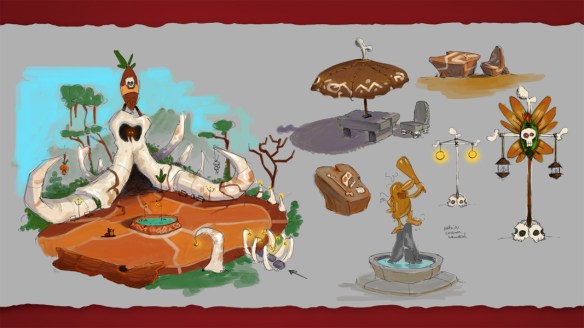
The PlayStation Blog post details how Kalypso designed their main character, a spider, and made him “charismatic and interesting”

“After a lot of brainstorming, coffee, comic reading, watching cartoons and lots of other inspirational tools, we thought that it would be interesting to play around with a small spider with big eyes that would be able to bring some “human” emotional connection to the game.” said Product Manager Andrew McKerrow.

“ We also decided to stick six legs on instead of the standard eight legs to make the character a little more friendly looking and little less creepy, as there are a lot of people with arachnophobia! See, we do care!” he added.

That however, was just the beginning, and the blog details how Alien Spidy went through different stages of concept art and designing a story for the game. It’s a very interesting read, which will surely be of interest to Train2Game students. It’s here on the PlayStation Blog.

What are your thoughts on the blog post from Kalypso? Does it give you a good insight into the game development process?

Leave your comments here on The Train2Game Blog, or on the Train2Game forum.

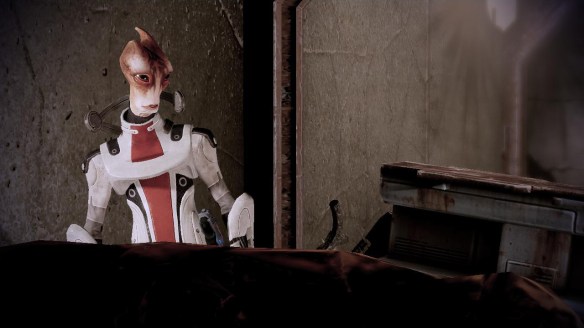
Train2Game news: Mass Effect writers on creating Mordin Solus

Train2Game students can get a behind the scenes look at the game design of Mass Effect 3 thanks to a video posted on the BioWare Blog over the weekend.

Titled ‘The Probletunity of Mordin Solus,’ the short video sees Patrick Weekes and senior writer John Dombrow at the BioWare and Mass Effect panel during PAX East, discussing the origins of the Salarian scientist.

They also discuss what makes Mordin Solus a memorable character, how he evolved through the series, and how he gets sent off in Mass Effect 3. Train2Game students who haven’t played Mass Effect 3 should be aware that this video contains spoilers. Watch it below.

There’s more BioWare news here on The Train2Game Blog, including advice from John Dombrow on how to get into the industry.

What are your thoughts on the video? What do you think makes a good character?

Leave your comments here on The Train2Game Blog, or on the Train2Game forum.

Train2Game news: Bioshock Infinite director Ken Levine talks game design with Uncharted writer Amy Hennig

Bioshock Infinite

Tran2Game students can get an excellent insight into game design, thanks to a podcast featuring Irrational Games’ Ken Levine in conversation with Naughty Dog’s Amy Hennig.

Ken Levine is the Creative Director of the upcoming Bioshock Infinite, while Amy Hennig has the same role on the Uncharted series. The Irrational Interviews podcast is therefore almost a must listen for anyone interested in video game story telling.

The two Creative Directors discuss creating complex narrative in a video game, how a large creative team works, and the challenges of their roles and how different it is to writing for film.

“It’s not the way films are made,” said Hennig.  “I’ve described this to friends of mine who are screenwriters, and they just think we’re insane.”

Download Ken Levine’s Irrational Interview with Amy Hennig here.

A previous podcast saw Levine discussing narrative with film director Guillermo del Toro, which you can find out more about here.

Will you be downloading this podcast? If so, let us know what you learned from the two Creative Directors.

Leave your comments here on The Train2Game Blog, on the Train2Game forum.

Train2Game news: Dungeonland developer diary discusses ‘designing for cooperation’

Train2Game students can get a look behind the scenes of Paradox Interactive’s upcoming co-op dungeon crawler Dungeonland, thanks to developer diary number one from Critical Studio.

Posted on the Paradox Interactive forum, the Dungeonland developer diary entitled ‘designing for cooperation’ explains what the team want from the game they’re making.

“When we design at Critical we start by answering the question: “what experience do we want our players to have?”With Dungeonland, we wanted to create a hack and slash game where players would play together. And we really meant “together”: we wanted players to collaborate in a meaningful way, to constantly talk, shout, laugh and curse at each other as they play.”

The post also details building the prototype for Dungeonland, and how that went onto influence the game as it currently is. There’s also a rundown of what Critical Studio label as their pillars of game design. 

The Dungeonland developer diary should make fascinating reading for Train2Game students, and you can read it in full here on Paradox Interactive’s forum.

There’s more Paradox Interactive news here on The Train2Game Blog, including our in-depth interview on the development of King Arthur II: The Role-playing Wargame.

What are your thoughts on the Critical Studio’s developer diary? How about Dungeonland itself?

Leave your comments here on The Train2Game Blog, or on the Train2Game forum.

Train2Game news: “It’s time for our medium to grow up” says Ubisoft’s Jade Raymond

Train2Game students will have become familiar with blockbusters such as Call of Duty or FIFA dominating sales charts, and comments on the Train2Game Facebook page find this to be a real shame when games with a deeper narrative don’t get the attention they deserve.

However, those with that opinion aren’t alone, as Ubisoft Toronto boss and Splinter Cell producer Jade Raymond believes its time game designers stopped relying on simple stories, and really started to explore narrative.

“I really do feel it’s time for our medium to grow up,” she told CVG in an extensive interview.

“I think we don’t need to make the equivalent to a Michael Bay flick in order to sell five million copies. I think things can be exciting, have meaning and hit important topics, and I’m not the only one that thinks that.”

Raymond pointed to film and TV having success with productions that have deeper narratives.

“I think every other entertainment medium or art form does manage to have commercial success and have the viewers or audience think or be inspired. Games, I think, have even more potential than that given that on top of the narrative side we do have all of the gameplay mechanics and we create rule sets from scratch which can have any kind of meaning embedded in them.” she said.

“It’s not easy to do that, because it requires breaking our recipe and trying to find new recipes, but I think it’s an important thing for us to strive for.” The Ubisoft Toronto boss added, referring to her time as Assassin’s Creed producer.

Jade Raymond has previously offered advice on getting into the games industry, which you can see right here on The Train2Game Blog.

What are your thoughts on Raymond’s comments? Do you think the games industry needs to grow up?

Leave your comments here on The Train2Game Blog, or on the Train2Game forum.

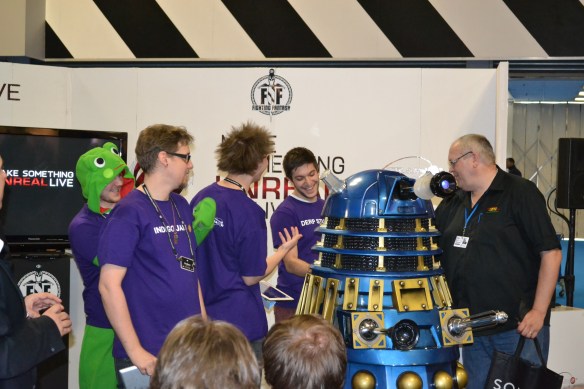
Look Who doctored a visit from a Dalek at the Train2Game stand at GSL?

Train2Game at Gadget Show Live gets a surprise visit from a Dr Who Dalek

Train2Game news: BioWare writer to give master class in games writing

Train2Game students have the opportunity to hear Star Wars: The Old Republic writer Jo Berry speak about game design, when she gives a public master class at Sheffield Hallam University later this month.

The BioWare writer is a graduate of the university’s Master’s degree in Creative Writing, who moved to the United States in 2008. The master class will see her pass on advice about creating dialogue and characters, building scenes that work both for the narrative and as exciting set pieces, and writing for voice actors.

“Attention to the quality of video game writing is increasing – gamers are demanding better storytelling and the industry is responding.” said Berry.

“Writing for video games is perhaps not something that creative writers would consider but it is an exciting career where your writing might find a home. I’m looking forward to coming back to the University and sharing my experiences with potential games writers of the future.” she added.

The public masterclass takes place in the University’s Norfolk Building, room 210 on Wednesday 25 April from 6:10 until 7.30pm. For more information, see the Sheffield Hallam website.

As previously reported by The Train2Game Blog, Star Wars: The Old Republic gained almost 2 million subscribers in its first month on sale.  Train2Game students can get an insight behind the scenes of the game, and advice on getting into the industry,  in our interview with BioWare Associate Lead Game Designer Emmanuel Lusinchi

There’s more Star Wars: The Old Republic news right here on The Train2Game Blog.

Will you attend the public master class with Jo Berry? What would you ask here?

As usual, leave your comments here on The Train2Game Blog, or on the Train2Game forum.

Train2Game news: Mass Effect 3 senior writer on getting into the games industry

Train2Game students looking to get a job in the industry should be playing games, and anaylsing their strengths and weaknesses as they do so. That’s according to Mass Effect 3 senior writer John Dombrow.

“Find what you’re good at and then keep getting better at it. Whether it’s writing, designing levels, creating sound FX, doing concept art – you’re only as good as your product.” he told the BioWare Blog.

“You should play games all the time, see what works, what doesn’t, and learn from the successes and failures of others.” he said, before adding that getting ahead in the industry, to for example, become senior writer for Mass Effect 3, takes a lot of work.

“But also be realistic – you’re not going to land your first job in the industry as Lead Designer. Be prepared and willing to work hard starting from the ground floor, improve your craft, and eventually you can get where you want go.” Dombrow said.

The full interview is over on the BioWare Blog, and should provide interesting reading for Train2Game students, as the Mass Effect 3 writer discusses the best part of his job, his average day and more.

The Train2Game Blog has previously spoken to BioWare co-founders Dr. Ray Muzyka and Dr. Greg Zeschuk, who offered Train2Game students their own advice on how to break into the games industry.

There’s more news from BioWare  here on The Train2Game Blog, where you can also find plenty more advice from industry professionals on getting into the industry.

What are your thoughts on the advice from the Mass Effect 3 senior writer? Do you already analyse the games you’re playing?

Leave your comments here on The Train2Game Blog, or on the Train2Game forum.

Train2Game news: Rayman Origins developer on benefits of ‘less is more’ game design

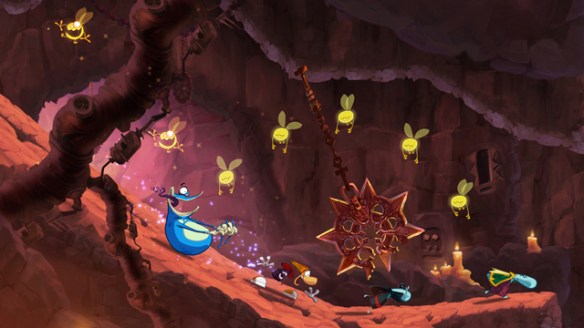
Train2Game game designers should find Rayman Origins designer Chris McEntee’s discussion of Ubisofts ‘rational design’ interesting, as he explains how he believes its key to success in game design.

“Rational design is all about eliminating unnecessary information, making things inherently readable, understandable and apparent, introducing mechanics in an orderly and easily digestible fashion, and preserving the learning and difficulty curves of a game, known as macro flow.” McEntee told Gamasutra in a huge feature on game design.

“In principle, it is best to provide a player with significantly interesting and deep mechanics that are well explored and exploited through clever rationalized level design, rather than injecting the game full of one-shot gameplay mechanics to feign depth.”

The Rayman Origins designer added that when it comes to game design, keeping it simple with a less is more approach is a good philosophy to follow.

“We try, as designers, to overstuff our games with content, ideas and objectives because we think that makes it more clever or fun,” said McEntee.

“When we rationalize our game systems and keep things simple but deep, we can truly create a good and meaningful gameplay experience that is also efficient for the team and easy to troubleshoot through iterative play-testing.

“I feel that rationalization is one of the keys to success in the game design field.” he added

Train2Game students can read the full 8 page feature on game design over at Gamasutra.

What are your thoughts on the idea of less being more as a philosophy for game design?

Leave your comments here on The Train2Game Blog, or on the Train2Game forum.

Train2Game interview: SoulCalibur V game director Daishi Odashima

Train2Game recently sat down for a chat with SoulCalibur V game director Daishi Odashima. In this interview with The Train2Game Blog, Odashima discusses development of SoulCalibur V, ongoing plans for DLC, the importance of community feedback and more. He also reveals what he thinks makes a good game designer!

Read the interview right here on The Train2Game Blog.

Tell us about your role as game director.

I’m game director for SoulCalibur V and I’ve been in the team since SoulCalibur III. On SoulCalibur IV I was a game designer, in charge of character designing in game design. In SoulCalibur V I’m the director.

How do you go about designing SoulCalibur V so that all the characters are balanced?

Basically, we see how the players play, and if the players feel that some characters are too strong then we would tone them down. Of course, if they’re too weak vice versa. For SoulCalibur V, we have chances for players to play before the game is out, where there isn’t a full roster of characters, but we have them play and get their feedback. We use that to balance our characters.

So, testing is a huge part of development before the game is released?

It is an important thing but it isn’t the only thing. Like if we receive feedback over a certain character being too strong, we test it in our own development, we play against each other and sometimes we agree, sometimes we disagree but the final decisions I make. So if I feel [a character] is too strong, then it’ll be balanced.

In the latest update, some characters have been tweaked following user feedback. How important is community feedback, and will that continue to be important for SoulCalibur V?

It’s really important because in our development we only have less than ten people balancing the character. On the other hand you have more than a million, maybe two or three million, playing and they upload their tournament videos, they write opinions on forums and of course we check all that sort of stuff and it’s really important. But it’s not just taking their opinions, we have to gather them up and we have to come up with the final decision, so it’s really important.

Tell us about the plans for SoulCalibur V DLC.

There’s lots of DLC to come for SoulCalibur V to use in the creation mode, which should be coming every four weeks and there are tonnes of parts to come.

Speaking of creation mode, SoulCalibur V players have uploaded many costumes and characters, can you see yourself taking a community created costume and adding it as official DLC?

We look at them and we think that they’re interesting, but we don’t simply take them, we look after it. Also, we have lots of costume designs that weren’t used for SoulCalibur V that can maybe be used for SoulCalibur VI, and basically these designs are determined by the designers who have the final say.

What was the the reason for focusing SoulCalibur V’s story on two characters, rather than the whole roster?

Our first plan on the storyboard was that we had every characters story, and actually we do have it in the studio, but time-wise, man power-wise we weren’t able to do it and only one fourth of what we planned to do is in the game.  Actually, some of the voice-overs are already taken but haven’t been used, so we want to make use of it somehow, but we don’t know how that’s going to be.

What are you most proud of about SoulCalibur V?

I feel that SoulCalibur V is the best fighting tool in this world. For online mode, the lobby system is really made well, also we truly believe that after the character balancing patch it’s going to be a lot better, and I’m pretty sure that any people who are really competitive, or if you’re just starting a fighting game,  can enjoy SoulCalibur V as a fighting tool.

A bit about you now, how did you get started in the games industry?

I was invited by a friend to a QA section at another game developer. From there another friend at Namco, who was originally a SoulCalibur competitive player, invited me to the SoulCalibur team for character balancing, and well, here I am now.

What advice would you give to anyone looking to get into the industry?

Well, my case was really special because I was invited as a specialist of SoulCalibur and this is a rare case. But what I think is important in becoming a game designer being able to describe what is happening within the game: what is fun, the logic behind it and also the communication skills to be able to explain this to other people.  Those skills are really needed to become a game designer.

Thanks for your time. 

As usual, leave your comments here on The Train2Game Blog, or on the Train2Game forum. Many more Train2Game interviews can be seen here. 

SoulCalibur V from Namco Bandai is out now for Xbox 360 and PlayStation 3.