More details about LittleBigPlanet 2 revealed

LittleBigPlanet 2 collectors edition

Media Molecule has revealed a checklist of things to do before the game that every Train2Game Games Designer should be interested in is released next month– LittleBigPlanet 2.

The US PlayStation Blog shows the full checklist of things Media Molecule have and haven’t done ahead of LittleBigPlanet’s release. It gives a little insight to Train2Game students to things away from games development that need to be completed before a new console title is released.

The final box art for both the standard and special editions has been done, and that smiling image of Sackboy you see above this Train2Game blog is what will be hitting store shelves in January. LittleBigPlanet 2 now also has its ERSB rating confirmed as E for Everyone. Be warned, the game contains comic mischief and mild cartoon violence!

Sackboy will no doubt be pleased LittleBigPlanet 2 contains only mild cartoon violence, given that during development of the original game, he was supposed to die in much more violent ways! You can read more about the development of Sackboy in this Train2Game blog post from November.

The US PlayStation Blog also reveals that a LittleBigPlanet 2 demo will be with us shortly. It’s currently being prepared and from December 22nd Train2Game students will be able to try out a little taster of the game.

We’re also shown that a Kevin Butler advert for LittleBigPlanet 2 is in the works, there’s a Sackboy costume and you’ll even be able to wrap gifts up in LittleBigPlanet 2 wrapping paper. The LittleBigPlanet 2 in-store displays for retailers have also been finalised and are ready to roll out for the game’s release next month. (Be sure to check out Gabe’s Thoughts of Train2Game blog that examines what it takes for a game to be a success at retail)

There’s also a new video that shows some of the new features Train2Game students can expect in LittleBigPlanet 2, pins and voice acting, which you can see in full below.

LittleBigPlanet 2 surely is a must for any Train2Game student, given that the beta test has shown that players can really let their creative juices flow when it comes to not only creating new levels, but entirely new games! Highlights include reimagining for classic games including Dogfight and Street Fighter and even more recent games such as Portal. Media Molecule even has a track record of hiring community designers who’ve made excellent levels, so Train2Game students really should look into LittleBigPlanet 2!

LittleBigPlanet 2 is released for the PlayStation 3 on January 18th.

You can leave your thoughts about LittleBigPlanet 2 here on the Train2Game blog, or on the Train2Game forum.

Could Train2Game students develop games for an Apple console in future?

Apple Train2Game

Train2Game students are very aware that Apple’s iPhone is one of the best platforms to start in the games industry. The App store provides a portal for small independent developers to distribute games to a very wide audience, and some like Cut The Rope go on to be very, very successful indeed.

(Games Industry consultant Nicholas Lovell recently told Train2Game about how indie games developers can distribute their games)

There was a time where nobody would have expected a mobile phone produced by Apple to become such a force in the world of mobile gaming, so what else could the company try their hand at? Well, according to EA Senior Vice President Patrick Soderlund Apple could develop a games console and challenge Microsoft’s Xbox 360 and Sony’s PlayStation.

CVG asked Soderlund if Apple were to move from mobile gaming into mainstream gaming, if they could challenge the established giants. The EA Vice President replied:

If it was anyone but Apple, I’d say that’s going to be very hard,”

“I still think it’s going to be extremely hard for them but they’ve surprised many people before.

“Look at what they did with the iPhone, right? They are a truly brilliant company so I would give them a relatively good chance to succeed if they tried.”

In October, there were rumours that Apple were going to purchase one of the giant games companies, while Nintendo boss Reggie Fils-Aime is on the record saying that Apple are the biggest threat to Nintendo.

Naturally, if Apple did decide to produce a games console of their own in the future, it could eventually provide another platform for Train2Game students to develop games for.

So Train2Game, do you think Apple will attempt a move into mainstream gaming in future? If so, do you agree with the VP of EA that they could actually succeed?

As usual, you can leave your thoughts here on the Train2Game blog, or on the Train2Game forum.

Train2Game interview with games industry consultant Nicholas Lovell – Part 2

Train2Game recently caught up with founder of Gamesbrief and industry consultant Nicholas Lovell. In a wide ranging interview he discussed subjects including the different types of game development studios, advice for small independent developers, social gaming and the business side of the industry.

The Gamesbrief founder also told Train2Game about a special offer on his book, How to Publish a Game. The 200 page book is available for half price until December 7th.

In part two of this three part interview, Nicholas Lovell tells Train2Game about how an independent developer can go about successfully distributing and marketing their games.

Part one of the Train2Game interview with Nicholas Novell is available here, while you can see part three here.

Train2Game: How would an independent developer actually go about distributing their game be it online, through social media, or mobile phones?

Nicholas Lovell: In my definition – what I use in the book distribution involves getting code into people’s hands. But marketing and distribution start blurring because there’s a large sense that distribution is about the channels by which you encourage people to know about your product and want to buy it.

On the distribution side – the literal process of getting code from your hands into your customers’ hands – if you’re publishing on Apple, Xbox Live, PSN, Android… they handle it. You upload your game to Apple, Apple takes the money and delivers the code so you don’t have to worry about that.  You still have to worry about discoverability so we’ll move onto marketing in a second.

If you’re doing something on Facebook or the broader web you have to handle it. So I strongly recommend you would use a scalable cloud backend like Amazon Web Services – something like that – which will cost you money and if you don’t have a business model, it will cost you more money which will be more expensive. You need to make sure that the more successful you get it isn’t the case you lose more money. I’ve had one client who the more successful they got the more money they lost. We fixed that now but that was the case.

If you’re looking at Flash development – I think it’s much harder to make money from Flash development – but if you’re looking at Flash development then there are sites like Kongregate, like Newgrounds.

In fact there’s a blog post on Gamesbrief, it’s a Preloaded blog post which talks about how they consider distribution, which you might want to look at.  [How we publish an online game]

Let’s move onto the marketing side, because distribution and marketing are often very tightly linked.  In my mind, distribution is simply ‘can they get it?’ Marketing is ‘do they want to get it? And there are a bunch of ways in which you can market your content, and they don’t have to be that expensive.

My view is that the primary objective of most of the marketing you do is to be able to talk to people again.  It’s not to sell them a product, because it takes longer to sell a product than just the first time seeing your banner ad.  [The customer going] ‘Oh I’m going to see that ad, click on it and buy immediately’ …that’s pretty unusual.

What your marketing activity should be about is to try and get people to allow you to talk to them again.  So that’s about Twitter feeds, that’s about blogs. Your social media strategy should be about being open, honest and clear, and about building a persona. There’s a lot of talk about building a story;  if you’re three struggling students, ask for help from the community, ask for people who read your blogs to tell you how to do stuff, start engaging in that kind of dialogue and build that over time. So that’s one aspect.

The second aspect of it is virality. Virality is much, much harder than it used to be, march harder and particularly on Facebook. There are two different types of virality. There’s mechanical virality, that’s the kind of stuff where you get spammed on your Facebook feed.  And there’s the ‘this is really cool’ kind of virality where word of mouth is key.

Certainly I’ve discovered games like Words With Friends, like Angry Birds, like Flight Control, because everyone was talking about them.  Personally I think that’s tough to rely on because it’s really, really hard to build a game that gets that level of success. Better is to have some way of encouraging people to want to play with their friends. However, I think virality is falling in terms of its level of importance.

Where I tend to focus – and why I’m not really a big fan of a business model which involves you just selling the product for a one off fee – is less on the how do you acquire customers, but more on how do you keep them, and how do you make money from them.

So let me give you a reason why:  On the iPhone, only 1.3% of apps have in-app purchases. Most people’s business model is free plus premium at 99 cents or so. But 33% of the top 100 grossing titles have in-app purchases.  So in other words, we’re getting to the stage where it is really, really hard – you can do it, Angry Birds has made over $10 million from a 99 cent purchase – but that’s very hard.

The guys who are making more money are allowing people – if they like the game – to keep upgrading. And instead of the maximum amount of that money you can make from customer being 99c you can make $5, in some cases $30.

There’s a game called Pocket Frogs which has in app purchases of values of 99 cent, $4.99 & £29.99. Only 8% of people by the $29.99, but in revenue terms, more than half their revenue comes from those bigger packs.  And most businesses stop at the 99c level, they would make a tenth of the revenue of Pocket Frogs. [For a full run down on the success of Pocket Frogs, check out this article on Gamesbrief]

Part one of the Train2Game interview with Nicholas Lovell can be seen here. The third and final part is available here.  His book, How to Publish a Game, is available for half price until December 7th.

You can leave your thoughts here on the Train2Game blog, or on the Train2Game forum.
Turbulenz funding programme could be perfect launch pad for Train2Game students

Turbulenz Launch Pad Funding Programme

Technology company Turbulenz are providing an opportunity that is too good for any Train2Game student to ignore.

They’ve created a Launch Pad Funding Programme which will “will subsidise and promote the development of up to ten games created with Turbulenz. Awards of €10,000 to €50,000 per game are available for products that help push the social gaming revolution.”

The good news is that anyone can apply to get involved, and that of course includes Train2Game students.

The idea of the Turbulez Launch Pad Funding Programme is to help ambitious developers to build unique, new browser based games.  There’s funding for up to ten teams, to help cover salaries of the people building the games. This game doesn’t even have to have been started yet, which means this is a great opportunity for Train2Game students to pitch their original ideas to Turbulenz.

Turbulez are looking for games that take full advantage of their game engine and online platform, and they are therefore looking at four key criteria, as listed on the Launch Pad Funding Programme website.

  • Mass appeal. Games that have mass market appeal online. The more inclusive a game can be, the better. Think about something that captures everyone’s imagination and creativity. Make sure you think about boys and girls, and especially all the mums and dads. Everyone is playing games online now.
  • Online payment. Games that naturally suit the payment models which are becoming successful online. People don’t want to pay 50 bucks anymore. So how is your game going to entice people to play and ultimately pay
  • Iterative development. Games that can evolve over time. Just look at how all the Flash games have developed. They start small and light, and gradually ramp up, developing new features in response to their playing community. It’s great to have a vision, but try and pull it back to something that can grow step by step.
  • Something new. Games that can take browser games to the next level. The web gives us the opportunity to blend everything it has to offer into our new games. Social gaming is only in its infancy and we fully expect a new generation of games to blow everyone away.

The deadline for Launch Pad Funding Programme submissions is Friday 14th January.  Turbulenz say they’ll start looking at applications as soon as they receive them, so the earlier your application gets in the better chance you’ll have!

All the information required for any Train2Game student that wishes to submit an idea to Turbulenz can be found on the Launch Pad Funding Programme website.

As usual, you can discuss this here on the Train2Game blog, or on the Train2Game forum.

Media Molecule reveal development of LittleBigPlanet’s Sackboy

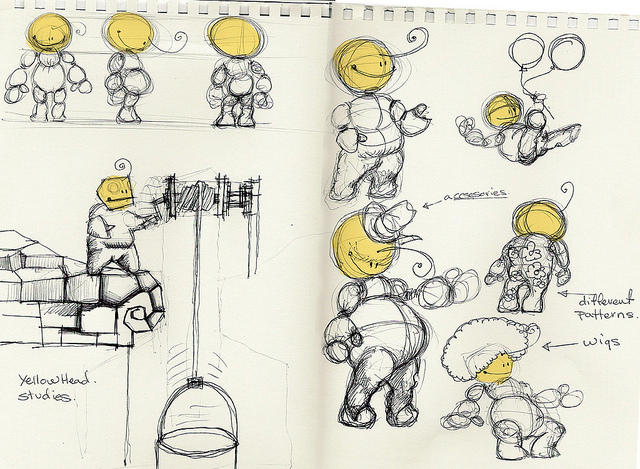
Two years on from the release of LittleBigPlanet, Media Molecule have revealed how the Sackboy we all know and love evolved from the original ‘YellowHead’ prototype. When Media Molecule showed the prototype of LittleBigPlanet 2 to Sony back in 2006, the character that would become Sackboy had already started to emerge – as you can tell by the animations in this video.

Obviously, Sackboy didn’t look anything like…a Sackboy…back then so how did he evolve? Well, to mark the two year anniversary of LittleBigPlanet, Media Molecule have decided to show us in this blog: From YellowHead to Sackboy. The article features an in depth look at how SackBoy developed from the Media Molecule developers, and is bound to be useful to any Train2Game student.

The YellowHead concept from the prototype video was kept in the early stages of the development of SackBoy as you can see below.

LittleBigPlanet YellowHead

Even at this stage you can see the concept of customising SackBoy was alive and kicking, with suggestions of different patterns, accessories and wigs available to create a unique character.

The YellowHead was eventually lost, and slowly but surely SackBoy evolved into the loveable little guy we know today.

LittleBigPlanet Sackboy Concepts 1

Sackboy Concepts 2

Even in these designs Sackboy isn’t the final version, with his legs becoming a lot longer in LittleBigPlanet. The designers at Media Molecule put this change down to Sackboy just not looking right while jumping and swinging around. Again, you can read more in depth comments about the evolution of Sackboy in this post on the Media Molecule blog

The article also shows that Sackboy’s deaths were originally going to be a lot more gruesome! He was to be squashed, burned into a pile of ash, and spill fluff when impaled on spikes. You can see Sackboy being killed in a variety of ways in this LittleBigPlanet concept art on the Media Molecule Flickr page. The video below shows some of death animations that Media Molecule experimented with for LittleBigPlanet. Of course, the final product ended up a lot more cartoon like!

The article was actually produced last year, but Media Molecule haven’t published it until now!  At that time, LittleBigPlanet 2 had yet to be announced so the knowing chuckles are obviously a reference to new things for Sackboy to do in the upcoming game.

In LittleBigPlanet 2, Sackboy will be able to do things including shoot anything from the creatinator, interact with the newly introduced Sackbots, and bounced like he’s never bounced before thanks to the introduction of bounce pads.

The LittleBigPlanet 2 beta has also shown that players can now be even more creative when it comes to creating levels. New LittleBigPlanet 2 levels created by the beta community so far include a recreation of Street Fighter and a LittleBigPlanet First Person Shooter, a user created version of beautiful indie game Flower, and, a reimagining of Portal complete with Portal Gun.

LittleBigPlanet 2 is set for release on January 18th 2011 for the PlayStation 3.

So Train2Game, what are your thoughts on the development of Sackboy? Did you realise how much effort can go in to creating a game character? And if you’ve been making your own games, how many times have you redesigned concepts?

You can leave your thoughts about the development of LittleBigPlanet, or LittleBigPlanet 2, here on the Train2Game blog, or on the Train2Game forum.

(Images: Media Molecule on Flickr)

A useful developer diary for Train2Game students: The technology of Mafia II

2K Games have released a developer diary that provides an insight into their upcoming title Mafia II. It should hopefully be of interest to all Train2Game students be they a Games Designer, Games Developer or Games Artist & Animator.

The Technology of Mafia II gives us a glimpse behind the scenes at 2K Czech and demonstrates the effort that’s been put into giving the sandbox action game an authentic 1940’s and 1950’s feel.

The developers tell us how they want the player to become fully immersed in the Goodfellas inspired rags to riches story. 2K Czech decided the best way to do this was to build their game engine – the Illusion Engine – from the ground up. It appears to have worked with Mafia II looking very impressive, with 2K Czech promising plenty of attention to detail.

We’re also told how the Game Developers and Game Designers want Mafia II players to feel like they’re playing a part in a classic gangster film, with the cut scenes designed to reinforce this impression.

The video gives an interesting insight into Game Development and could be very useful indeed to Train2Game students. Mafia II itself looks impressive and is released on August 27th. You can see gameplay footage and hear the developers’ insights by watching the video below.


So Train2Game, how would you feel about attempting to build a game engine from the ground up? What would you do to fully immerse players into your game world? And are you looking forward to Mafia II?

As usual, leave your thoughts here or on the Train2Game forum.

New LittleBigPlanet 2 trailer released…and it looks adorable.

Sony has revealed a new LittleBigPlanet 2 trailer on the PlayStation Blog, and it looks very promising indeed.

The Adventure trailer – for that is its name – shows some of the new tools and abilities at Sackboy’s disposal which includes commanding Sackbots, flying a spaceship, throwing enemies and using bouncy jump pads. You’ll need to use them all as you play through 50 levels in order to save Craftworld from the evil Negativitron.

Of course, the customisation tools available meant, LittleBigPlanet was more than just a platformer, and Media Molecule’s sequel just gives players even more options in this area. Not only can you create your own levels, you can create your own games. It’s something that every PlayStation 3 owning Train2Game student – especially the Games Designers – really should be looking into.

LittleBigPlanet 2 is due for release in the USA on November 16th, with a European release date rumoured to be coming at the upcoming GamesCom.

Still not convinced by it? Then check out the LittleBigPlanet 2: Adventure Trailer here below. If you don’t feel all warm inside then you probably have a heart made of stone.

So Train2Game, what do you think of the video? Of course, you like what you see, but what is your favourite new feature? And do you have any ideas for LittleBigPlanet2 levels or games?

As usual, leave your thoughts here or on the Train2Game forum.

DJ Hero 2 Multiplayer Developer Diary

Here’s another little developer diary that Train2Game students may find interesting. This one is from Freestyle Games, and features Creative Director Jamie Jackson talking about their upcoming title DJ Hero 2.

During the two and a half minute video, he speaks about DJ Hero 2’s six new multiplayer modes. These include Party Play, which lets you and friends freestyle through continuously running mixes at will, and Streak, a battle game that also let’s a vocalist join in on the action.

The other modes are DJ battle, head to head, Accumulator and Checkpoint challenge which are all explained in a bit more detail in the developer diary.

Jamie Jackson says the main idea behind the multiplayer modes of DJ Hero 2 is to ‘inspire a party in your living room.’ He also adds that the bars gone up and claims the games multiplayer modes have something for everyone. Reckon he’s right, Train2Game? Why don’t you tell us after watching the Developer Diary from Freestyle Games below? (Careful now, it contains ‘Mild Suggestive Themes!’)

So, have you thought about designing multiplayer games? Do you think it’s more difficult than doing it for a single player game? And do you like what you’ve seen of DJ Hero 2?

The game is released this autumn.

As usual, leave your comments here or on the Train2Game forum.

Another essential F1 2010 dev diary for Train2Game students

Codemasters have released another F1 2010 developer diary and once again it should make interesting viewing for Train2Game students, particularly the Games Designers.

Entitled Live the Life, and describes what is essentially the games story. You start off as a new driver, with the expectations placed upon you depending on your team and difficulty setting. The video is once again fronted by Formula 1 driver and Technical Consultant on F1 2010 Anthony Davidson, and he explains how your teams expectations are very authentic.

“The expectations for the driver playing the game are the same as in real life given your machinery. At the end of the day, the teammate that you have is the only direct competition you’ll have through the whole season. There’s a strange balance of having to work together but also this desperate competition. Where it gets a little bit personal is events like qualifying and the race where you’re just out there to beat him, no matter what.”

The video also demonstrates how you won’t just be driving the car, but will be involved in press conferences and other media duties with the in-game journalists’ questions depending on how well you’ve been driving. The video doesn’t reveal how this’ll affect the game, but perhaps it’ll be in the style of Football Manager where your reactions can either boost or lower the morale of your team. Or will your comments cause your rivals to almost run you into a wall?

Interestingly, the developers discuss how they’ve striven for realism in the garage by using motion capture from real F1 mechanics to make everything as close to the real thing as possible. Of course, there are also pit girls, whether or not they were motion captured isn’t revealed…

Anyway, you can watch Live the Life of a Formula 1 driver below.

If you missed the previous developer diary, which examined the work put into recreating the cars, you can watch it here.

So Train2Game, what do you think of this latest Codemasters F1 2010 Developer Diary?  Did you expect Games Designers to have to include a story and scripts for a racing game? And how would you like to use motion capture in one of your future games?

As usual, leave your comments here or on the Train2Game forum.

Interesting research into game facial animations

Emotions in games: More sophisticated than this.

Research by the University of Abertay into facial expressions could hold the key to making computer game characters with more realistic facial animations and emotions.

Robin Sloan, a PhD student and lecturer based in the University’s Institute of Arts, Media and Computer Games, has devised a set of rules that could help portray a more convincing facial animations and emotions. These rules will no doubt be very useful to Train2Game students, especially the Artist & Animators!

(Game Designers and Game Developers: you can read on, or watch the impressive F1 2010 Developer Diary that was pointed out yesterday)

The study involved a series of experiments examining how the upper and lower regions of the face move during expressions including happiness, surprise and anger.

The aim was to make every stage of the choreography as believable as possible. Actors were used in order to study realistic expressions induced by genuine emotions.

It was found that for sadness to look real, it needs to lead from the upper face with, the furrowing of the brow and lowering of the eyes should occurring before the mouth corners turn downward. If this expression unfolds the other way round, the study found it looked childlike or faked. (I’ve found the latter often occurs during Dragon Age: Origins, though the rest of the game is excellent!)

Similarly, for anger, initiating the expression with the upper face works best in practice with the lower face following thereafter – rather than gritting one’s teeth alone.

Choreography can also affect how clear the emotions are when observed by audiences, such as the gamer. For instance, disgust animations may look fairly authentic when the upper face leads, but the lowering of the brow can result in the expression being confusable with anger. In this case, leading with the lower face creates a more distinct disgust expression.

The team also studied emotional expression transitions, for example from happiness into sadness, or sadness into anger. Robin Sloan explains the findings:

“What we found in this second stage of the study was, for example with surprise into happiness, if the upper face moved before the lower face, this could result in an insincere happy expression which could be viewed as an exaggeration or, indeed, fake. This could be useful if animators deliberately wanted to create a fake smile, but would otherwise be unhelpful.

“On the other hand, when the lower face led the movement in this transition, the overall animation appeared much more believable. Likewise, for happiness into sadness, upper face leading seemed clear and credible, whereas leading with the lower face seemed childish or sarcastic, as if displaying an interpretation of sadness rather than genuinely portraying the emotion.”

He continued: “While much is known about the appearance and perception of emotional facial expressions, researchers and professionals still struggle to create perceptually believable animated characters. For example, films such as Polar Express and Beowulf are ‘performance-captured’ where the performance of human actors is transferred onto computer animated characters.

“However, the aesthetic results of this technique have not been fully embraced by the public, as it appears that audiences view the characters as fake and unrealistic. Indeed, we are often more likely to believe in characters from more traditional animation films such as Toy Story or Shrek – animations which are carefully crafted by teams of animators.

“While the computer animation research community is quite rightly interested in the technical possibilities of performance capture, we wanted to highlight the fact that traditional animation can still play an important role in research, and to show that an artistic approach to animation can yield tangible research findings. We feel that our research could, for instance, have implications for the development of believable computer game characters, as an understanding of what makes for believable facial expression animation can boost their credibility.”

Mr Sloan hopes that the results could be useful for Games Designers, Game Developers and Games Animators – like Train2Game students – seeking to create more believable and, more interactive characters.

The research was published in the Journal of Computer Animation and Virtual Worlds.

So, Train2Game universe,  what do you think of the study? How much have you thought about how animation works in your games? And what research do you do before animating characters?

As usual, leave your comments here or on the Train2Game forum.