Train2Game news: Ghost Recon: Future soldier public developer Q&A at BAFTA next week

Train2Game students have the opportunity to gain insights into the industry and development of Tom Clancy’s Ghost Recon: Future Soldier at a special Q&A event at BAFTA next week.

Ghost Recon: Future Soldier Creative Director Jean-Marc Geoffroy, Ubisoft IP development director Adrian Lacey and Tom Clancy’s Ghost Recon: Alpha short film director François Alaux will all be speaking at the game developer Q&A. It takes place at BAFTA’s central London HQ on the evening of Tuesday 24th April.

The Ghost Recon: Future Soldier Q&A could potentially provide Train2Game students with the opportunity to get advice on getting into the industry from the Ubisoft team. Those Train2Game students interested in attending the BAFTA event can book their free student place here.

There’s more information about Game Developer Q&A on the BAFTA website.

The Train2Game Blog caught up with Ghost Recon: Future Soldier developers last year. In an extensive interview, Game Director Eric Couzian, Lead Game Designer Roman Campos Oriola and Associate Producer Thomas Leroux-Hugon told us about development of the game and offered advice on getting into the industry. Read it here on The Train2Game Blog.

Keep reading the Train2Game Blog for the latest news and events from BAFTA Games.

Will you attend the BAFTA event? What would you like to ask the Ghost Recon: Future Soldier development team?

Leave your comments here on The Train2Game Blog, or on the Train2Game forum.

BAFTA’s public events and online resources bring you closer to the creative talent behind your favourite games, films, and TV shows. Find out more at www.bafta.org/newsletter,www.facebook.com/bafta or twitter.com/baftagames

Train2Game news: “It’s time for our medium to grow up” says Ubisoft’s Jade Raymond

Train2Game students will have become familiar with blockbusters such as Call of Duty or FIFA dominating sales charts, and comments on the Train2Game Facebook page find this to be a real shame when games with a deeper narrative don’t get the attention they deserve.

However, those with that opinion aren’t alone, as Ubisoft Toronto boss and Splinter Cell producer Jade Raymond believes its time game designers stopped relying on simple stories, and really started to explore narrative.

“I really do feel it’s time for our medium to grow up,” she told CVG in an extensive interview.

“I think we don’t need to make the equivalent to a Michael Bay flick in order to sell five million copies. I think things can be exciting, have meaning and hit important topics, and I’m not the only one that thinks that.”

Raymond pointed to film and TV having success with productions that have deeper narratives.

“I think every other entertainment medium or art form does manage to have commercial success and have the viewers or audience think or be inspired. Games, I think, have even more potential than that given that on top of the narrative side we do have all of the gameplay mechanics and we create rule sets from scratch which can have any kind of meaning embedded in them.” she said.

“It’s not easy to do that, because it requires breaking our recipe and trying to find new recipes, but I think it’s an important thing for us to strive for.” The Ubisoft Toronto boss added, referring to her time as Assassin’s Creed producer.

Jade Raymond has previously offered advice on getting into the games industry, which you can see right here on The Train2Game Blog.

What are your thoughts on Raymond’s comments? Do you think the games industry needs to grow up?

Leave your comments here on The Train2Game Blog, or on the Train2Game forum.

Train2Game Gadget Show Live interview: Overclockers UK on how to build gaming PC and more

Train2Game News visited Overclockers UK stand at The Gadget Show Live in the Birmingham NEC. While there, we spoke to Overclockers UK’s Mark Purdy, who told us a bit about what the company do, how to build your own PC and much more.  As usual, leave your comments here on The Train2Game Blog, or on the Train2Game forum. 

First of all, tell us a bit about Overclockers UK?

We are a high end gaming components and computer seller, an online retailer based in Newcastle-Under-Lyme. Visit us at www.overclockers.co.uk. At The Gadget Show we’re showcasing a range of gaming systems that you can come and try, we’ve got one that’s running Batman: Arkham City, one that’s running the Diablo 3 beta, and two that are running Battlefield 3. We also have a racing simulator with our own branded racing seat running Project Cars, and we have a flight simulator running Microsoft Flight. We have our show system, Ultimate Mammoth, which is a £6000 machine featuring brand new NVIDIA GTX 680 graphics cards.

We have stock for sale, which you can come and purchase. We also have a free shipping code on flyers that you can come along and grab. We are running daily competitions, doing build demos so you can learn to build your own computer, and also have our time on the main stage where we’re giving out bags full of goodies.

Building a computer is something many people will look at and think of as a tough task, but is it actually relatively simple to do?

I’m going to compare it to building Lego; putting in each component in the right place is just like slotting in pieces of Lego, as long as you know where it goes and can connect it up properly, and test it.  That’s what we’re going to be showing.

So, if someone wanted to build a high-end PC, what would you recommend they start with? What are the key parts they’ll need?

Look at the games you’re going to be playing, and make sure you build a system that’ll run the games nicely. There’s no point spending too much money on a system you’ll never use all of the full potential of the power.  Always get a system which you’re comfortable with, which will run the games nice and smoothly and won’t cost you too much. There are so many people who’ll go out and buy a few thousand pound machine and never actually use the full potential of it. You could spend £700 to £800 on a machine that’ll do your games running at high definition, while you play it nice and smoothly.

Where can people get more information about this, or Overclockers?

We have a Facebook page which people can go on to, which we update every day. We have a Twitter account where people can ask questions on. We have one of the UK’s largest forums as well, with over 100,000 members, where people can ask questions about hardware. If they’re not sure what to buy they can just go on and talk to our members and get information; if they have a budget and they’re not sure what to spend it on they’ll get recommendations.  And it’s just for general chit-chat, so we have a general discussion area where anything can go, a PC games section where people talk about the latest releases, and latest news and deals where we o do special deals just for the forum.

The forums are a key part of a good community then?

Yes, a very key part of the community. The business is built almost around the forums, the forums really helped the business take off back in 1999. So it was one of the best additions it could’ve had for marketing, especially for new products, it’s absolutely fantastic.

Thanks for your time.

Visit OverClockers UK  http://www.overclockers.co.uk/. As usual, leave your comments here on The Train2Game Blog, or on the Train2Game forum. 

Train2Game news: UK Charts – FIFA Street returns to top spot

Train2Game students see FIFA Street claim its fourth No.1 this week, as EA continue to dominate the UK charts.

FIFA Street reclaims top spot, after previously holding the position for three consecutive weeks before it was dislodged by Kinect Star Wars. EA’s Mass Effect 3 rises one to No.2, while FIFA 12 is No.3 in its 29th week on sale.

Kinect Star Wars drops to No.4 after debuting in top spot last week, while Tiger Woods PGA Tour 13 – another EA Sports title – is a non-mover at No.5. Call of Duty: Modern Warfare 3 is another non-mover, taking No.6 in its 23rd week in the charts.

Bethesda’s The Elder Scrolls V: Skyrim moves up three to No.7, sitting one spot ahead of EA’s Battlefield 3, which rises one to No.8. Mario & Sonic at the London 2012 Olympic Games slips to No.9, with the majority of its sales for Nintendo Wii, while former No.1 SSX completes the top ten.

Nintendo’s Pandora’s Tower is the only new entry into the top 40, debuting at No. 38.

The UKIE Gfk Chart-Track All Formats Top 10 for the week ending 14th April 2012 is therefore as follows:

1. FIFA Street (EA)
2. Mass Effect 3 (EA)
3. FIFA 12 (EA)
4. Kinect Star Wars (Microsoft)
5. Tiger Woods PGA Tour 13 (EA)
6. Call of Duty: Modern Warfare 3 (Activision)
7. The Elder Scrolls V: Skyrim (Bethesda)
8. Battlefield 3 (EA)
9. Mario & Sonic at the London 2012 Olympic Games (Sega)
10. SSX (EA)

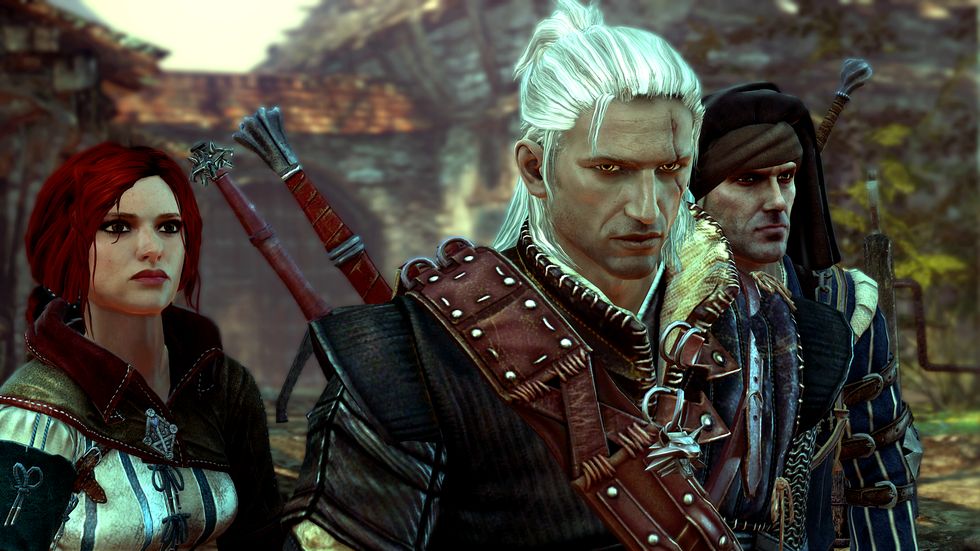
New releases this week include The Witcher 2: Assassins of Kings for Xbox 360 from CD Projekt. Read an interview with The Witcher 2 Environment Artist Marek Ziemak here on The Train2Game Blog.

What are your thoughts on EA’s continued dominance of the UK Charts top ten? Will it be broken by the release of The Witcher 2 this week?

Leave your comments here on The Train2Game Blog, or on the Train2Game forum.

Train2Game news: Commando Kiwi win Make Something Unreal Live with Fighting Fantasy Warlock of Firetop Mountain game

Train2Game student team Commando Kiwi is the winner of Epic Games and Train2Game’s Make Something Unreal Live, an unprecedented game development competition that took place at the Gadget Show Live.

Four teams presented their new iOS games based on individual books in the “Fighting Fantasy” series to the franchise’s esteemed creators, Steve Jackson and Ian Livingstone OBE, and the duo determined that Commando Kiwi’s fresh twist on the third-person adventure genre makes the best use of the property and exhibits the most outstanding commercial potential.

The studio’s winnings include a full source Unreal Engine 3 license for iOS that may be applied to a future project as well as a holiday at the luxurious AquaCity water park and resort in Poprad, Slovakia.

All four iOS games were publicly debuted this week and are primed for release on the App Store in the coming weeks through a new publishing deal with AppyNation.

Teams competing in Make Something Unreal Live have been developing their games since winning the Train2Game and Epic Game Jam last November. Five months of development went into overdrive this week at the Gadget Show Live, where students presented projects twice daily to industry legends, implemented changes based on expert critiques at a rapid pace and submitted their near-final games for today’s judging.

By using the Unreal Development Kit (UDK), the free edition of Epic’s award-winning Unreal Engine 3 technology, all four teams, whose members are enrolled in Train2Game’s blended learning courses, are poised to publish their games on the App Store under standard UDK licensing terms. A portion of the proceeds will be donated to The Prince’s Trust.

“Commando Kiwi really captured the essence of ‘The Warlock of Firetop Mountain’ with great gameplay and visuals,” said “Fighting Fantasy” author and co-creator, Ian Livingstone.

“It’s remarkable what these student teams were able to produce working remotely for such a short period of time using UDK. Although only one of the teams has won this amazing prize, the experience students have gained is invaluable and I fully expect to see many of them working in the video games industry.

“We look forward to playing these games, and Steve and I are sure that Fighting Fantasy fans everywhere will really enjoy these new interactive experiences based on the books.” he added,

“I’m just dead proud of my team. They’ve worked really hard and this competition has changed our lives forever,” said Jonny Robinson, producer of Commando Kiwi and team captain for Make Something Unreal Live.

“The quality of the games produced for the Make Something Unreal Live competition at Gadget Show Live is a testament to the teaching that the students have received on Train2Game courses,” said Myra Smallman, course director, Train2Game.

“The competitive process that they have been through should give them a glimpse of what it’s like to work in a professional studio and the experience should go towards giving them the skills to gain employment in the games industry.”

Epic Games European Territory Manager and Make Something Unreal Live mentor Mike Gamble summed up the dramatic conclusion to the competition. “Priming the next generation of game developers benefits the industry as a whole. This competition may be over but the journey for four new studios has only begun.”

There’s more information on Make Something Unreal Live here on The Train2Game Blog, while we’ll keep you up to date on the future progress of Commando Kiwi.

As usual, leave your comments here on The Train2Game Blog, or on the Train2Game forum.

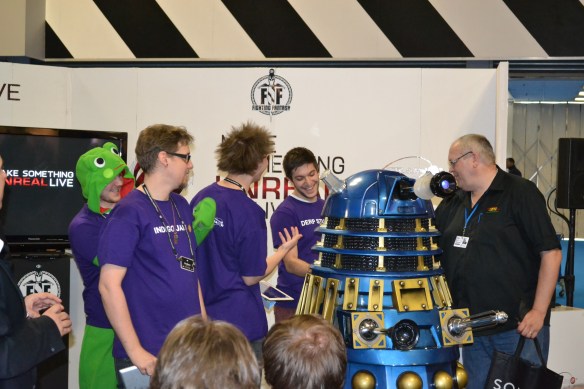
Look Who doctored a visit from a Dalek at the Train2Game stand at GSL?

Train2Game at Gadget Show Live gets a surprise visit from a Dr Who Dalek

Train2Game news: BioWare writer to give master class in games writing

Train2Game students have the opportunity to hear Star Wars: The Old Republic writer Jo Berry speak about game design, when she gives a public master class at Sheffield Hallam University later this month.

The BioWare writer is a graduate of the university’s Master’s degree in Creative Writing, who moved to the United States in 2008. The master class will see her pass on advice about creating dialogue and characters, building scenes that work both for the narrative and as exciting set pieces, and writing for voice actors.

“Attention to the quality of video game writing is increasing – gamers are demanding better storytelling and the industry is responding.” said Berry.

“Writing for video games is perhaps not something that creative writers would consider but it is an exciting career where your writing might find a home. I’m looking forward to coming back to the University and sharing my experiences with potential games writers of the future.” she added.

The public masterclass takes place in the University’s Norfolk Building, room 210 on Wednesday 25 April from 6:10 until 7.30pm. For more information, see the Sheffield Hallam website.

As previously reported by The Train2Game Blog, Star Wars: The Old Republic gained almost 2 million subscribers in its first month on sale.  Train2Game students can get an insight behind the scenes of the game, and advice on getting into the industry,  in our interview with BioWare Associate Lead Game Designer Emmanuel Lusinchi

There’s more Star Wars: The Old Republic news right here on The Train2Game Blog.

Will you attend the public master class with Jo Berry? What would you ask here?

As usual, leave your comments here on The Train2Game Blog, or on the Train2Game forum.

Train2Game news: Valve developing own “platform hardware” says job advert

Train2Game students will be aware that Valve have long been innovators when it comes to developing software, with games such as Half-Life and Portal being classed as all-time greats, while Steam revolutionised digital distribution of games.

But now it seems Valve are looking to develop their own hardware, according new job advert for an Electronics Engineer at the company.

“We’re developing hardware to enhance those experiences, and you can be a key part of making that happen. Join our highly motivated team that’s doing hardware design, prototyping, testing, and production across a wide range of platforms,” reads the Valve job advert.

“We’re not talking about me-too mice and gamepads here – help us invent whole new gaming experiences.”

The main duties of the role are listed as “Work with the hardware team to conceive, design, evaluate, and produce new types of input, output, and platform hardware”

Earlier this year, rumours suggested Valve might be building their own PC or console system, which was dubbed by the internet as ‘Steam Box’ The rumours were denied by Valve, but could this be it?

Keep reading The Train2Game Blog for all the latest news from Valve, including our interview with Counter-Strike: Global Offensive writer Chet Faliszek, who offers some great advice to Train2Game students about getting into the industry.

What are your thoughts on Valve’s job advert? Do you think they’re looking to launch a console? If so, do you believe it can be successful?

Leave your comments here on The Train2Game Blog, or on the Train2Game forum.

[Source: Engadget]

Train2Game news: Next-gen consoles will increase “creative freedom” says Witcher 2 developer

Train2Game students who think like The Witcher 2 lead level artist Marek Ziemak will probably support the CD Projekt developer in wanting much improved graphics and animation for next-gen consoles, in order to create better experiences.

“Sure, I’m a level artist so for me, it’s all about the visual quality, I want more creative freedom and more great graphics, that’s what really makes me want to create games.” CVG report the level artist saying at this week’s Witcher 2 developer Q&A at BAFTA.

“I’m looking for like real-life animations. It’s like pushing the limit again and again, creating bigger and greater stuff,” Ziemack continued. “I don’t know when it’s going to happen, but I want to see this, these great graphics being there on the screen.

“I hope its time comes soon and we won’t have to fight about pixels on the screen but worry more about delivering a true experience, the real emotion we can deliver through the game.” he added.

The Witcher 2 lead level artist has previously spoken to the Train2Game Blog, with our full interview with Marek Ziemak available to read here.

The Witcher 2: Assassin’s of Kings is released for Xbox 360 on Tuesday 17th April. For more news about The Witcher 2, keep reading The Train2Game Blog.

What are your thoughts on Ziemaks comments? Would better graphics bring more creative freedom?

Leave your comments here on The Train2Game Blog, or on the Train2Game forum.

Train2Game Gadget Show Live interview: Centre for Computing History Curator Jason Fitzpatrick

Train2Game News visited The Centre for Computing History stand at The Gadget Show Live in the Birmingham NEC. While there we spoke with the museum’s trustee and curator Jason Fitzpatrick. In an in-depth interview, he discussed the aims of the centre, the importance of programming, the museum’s upcoming move to Cambridge and more.

Listen via Train2Game Radio, or read the interview below. As usual, leave your comments here on The Train2Game Blog, or on the Train2Game forum.

What is the Centre for Computing History?

It’s a computing history museum, currently based just outside of Cambridge, but we have some sponsorship from companies like ARM and Microsoft Research who have helped support us, and we’re now going to open up in Cambridge in the next couple of months.

What are the main aims of the centre?

It’s the history of computing in general, and we’ve got a bit of a different slant on it because obviously computers are important for that they are, but it’s looking at computers and how they’ve changed us. The term ‘personal computer’ is very much more personal than anyone thought it would be, so having something like computers and the way they interact with our lives and changed the way we are is something that we’ve taken for granted.

So we go on the internet now, shop, and that’s just what you do. But going back to the early 1980s, it wasn’t something you could even dream of doing, so it’s a really short space of time, but things have changed completely, so it’s looking at machines and how they’ve changed things.

And all of the computers are on display here at The Gadget Show Live for people to look at or even use.

Yeah, absolutely! The museum wants to be interactive, so we want to have these things out and people can use these things, play the games as they were, feel how the machines and the keyboards were like. Otherwise, they’re just beige boxes of nothing, but to have one on and see it in use, that means everything.
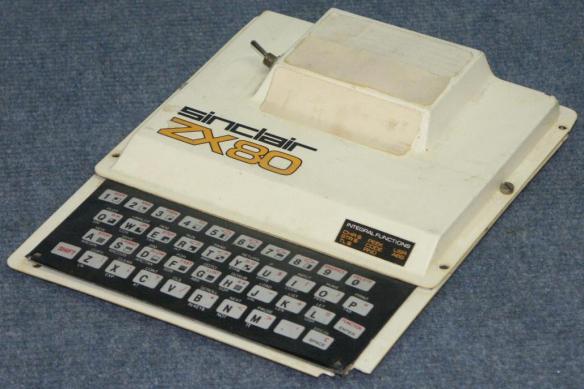
Now when people play games, they just need to take it out the box or download it first, but back in the 1980s you had to code it yourself. Are those types of machine to see? And is programming something that’s lost on the younger generations?

Yes, certainly. Go back to the 80s and you were typing in magazine games – and most of the time they were wrong anyway – so you’d then spend time trying to work out why they were wrong, and in doing that you were learning programming.  Certainly it’s important, and it’s something we’re very much keen on doing; we take a fleet of BBC Micros out to schools and let kids program them.

For some of those kids it’s quite an eye opener, they don’t even know you can program a computer, which is really strange for me, but that’s the way it is, they’ve just grown up with computers and they’re just ways of accessing the internet or using Word. So, I think programming is a bit of a lost art form, and it’s important that we get it back into schools and into the curriculum, and we’re trying to play our part in doing that.

How do you go about selecting what’s on show in the Centre for Computing History?

It’s really difficult, like choosing your favourite child! Really, it’s about trying to change it from last year, so for this event [Gadget Show Live] we had some other machines on display, so we’ve put those aside this year and do a different selection. For the museum, again, we’re going to keep it fresh, we’re going to make sure that it changes fairly regularly. Because in the 80s there were hundreds of machines, computers and games consoles that came out. You couldn’t have them all on display at the same time, but we can change them around, so that’s what we’re going to do, we’re going to have different displays on at different times.

How difficult is it to maintain the computers? Parts, especially for the older ones, can’t be easy to find.

Yes, it can be difficult sometimes. But we’ve got a lot of support from the general public, it’s really nice, so we get a lot of donations in. And people email us saying “I’ve got an old Commodore 64, but it doesn’t work, do you want it?” But we’ll take it, because it could be used for parts as we have a mountain of old machines that are in various states of working and we basically live off those. So we either try to get those working by fixing them specifically or using the parts to fix others.
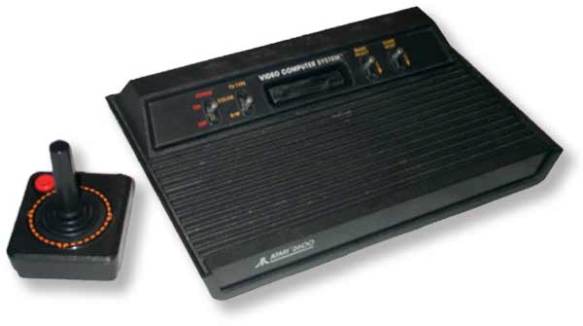
How is the museum going to be funded?

There’s a lot of love in it, I must admit. There are a lot of volunteers that do things for the museum like coming out to events and supporting it, fixing the machines, do various things. But it does have a certain amount of funding, from ARM, Redgate Software and Microsoft Research in Cambridge, and they’ve put money into physically moving us into Cambridge.

After that, once we’re there, we’ve got to build the museum ourselves, so we’ll be looking for sponsorship or donations of equipment to physically build the museum. Once we’re there, and we’re opened, then people will pay on the door to come and see us and we’ll just work like any museum, with a shop, cafe, things like that.

But we’re also a little bit different, in that we take a lot of this old technology, and make it available to TV and film companies.  So we then supply this old stuff, or make it do something different, doing documentaries, so that’s another revenue generating things for the museum that keeps it ticking over.  There are a few bits of business we can do to keep things going.

When will the new museum open, and where can people get more information?

Museum version 1 is currently in Haverhill, Suffolk which is going to close its doors for awhile as we move over. Museum version 2 will be in Cambridge and you can go to the website www.computinghistory.org.uk where there’s all the information about the move and when we open. We hope to open in a couple of months. So go on there, follow us on Twitter and Facebook and keep abreast of what we do.

Finally, if there’s one piece of equipment here you could say is the most significant, what would that be?

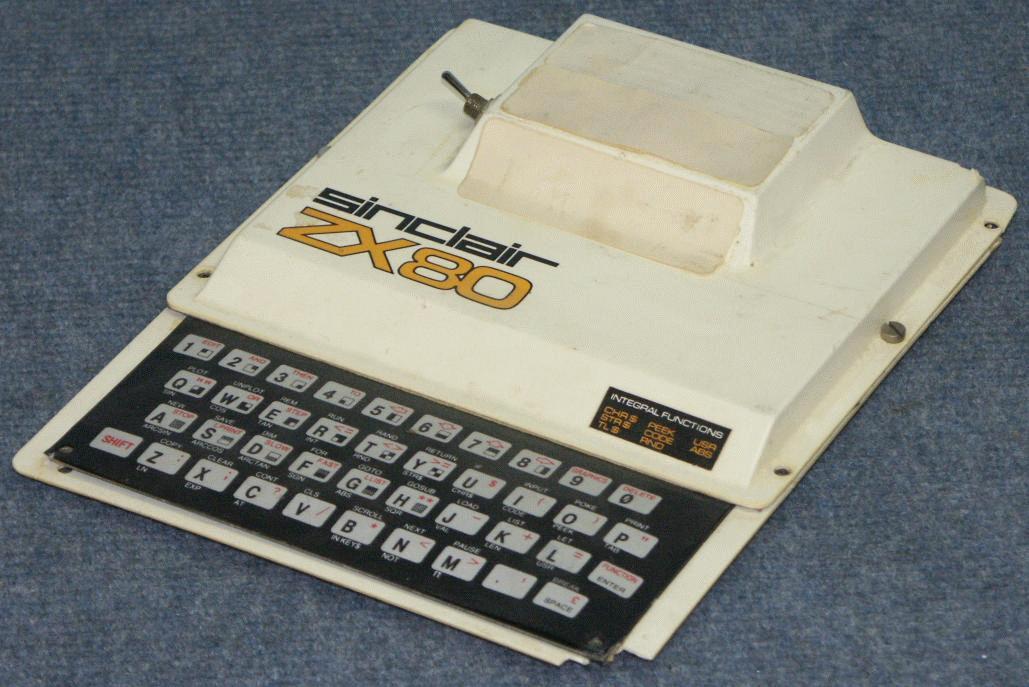
That’s so hard, because there are lots of significant items in different areas.  For me, in gaming, the Atari 2600; it’s a bit of a personal one because I had one, I was quite lucky. So, that for me is really important because it started the whole cartridge based console system. There were things before it, but it really made cartridges popular. Equally, I think we’ve got things like the ZX80 computer which brought computing down to a price that was affordable, so that’s important. I think I could go round every decade, but those two are my favourites.

Great thanks, for your time.

For more information, go to www.computinghistory.org.uk