Train2Game News Iron Man Costume part 2

image

Train2Game student Sheldon Gilman has made it his mission to create the ultimate Iron Man suit. He also has plans to create more suits from the popular Iron Man series of films.

He’s recording his journey in creating these wonderful creations via the Train2Game blog.   Posting updates on his own creations while giving advice to other aspiring costume makers.

In this latest entry to his blog, he discusses software used to create his design, mould creation and some of the setbacks he has encountered.

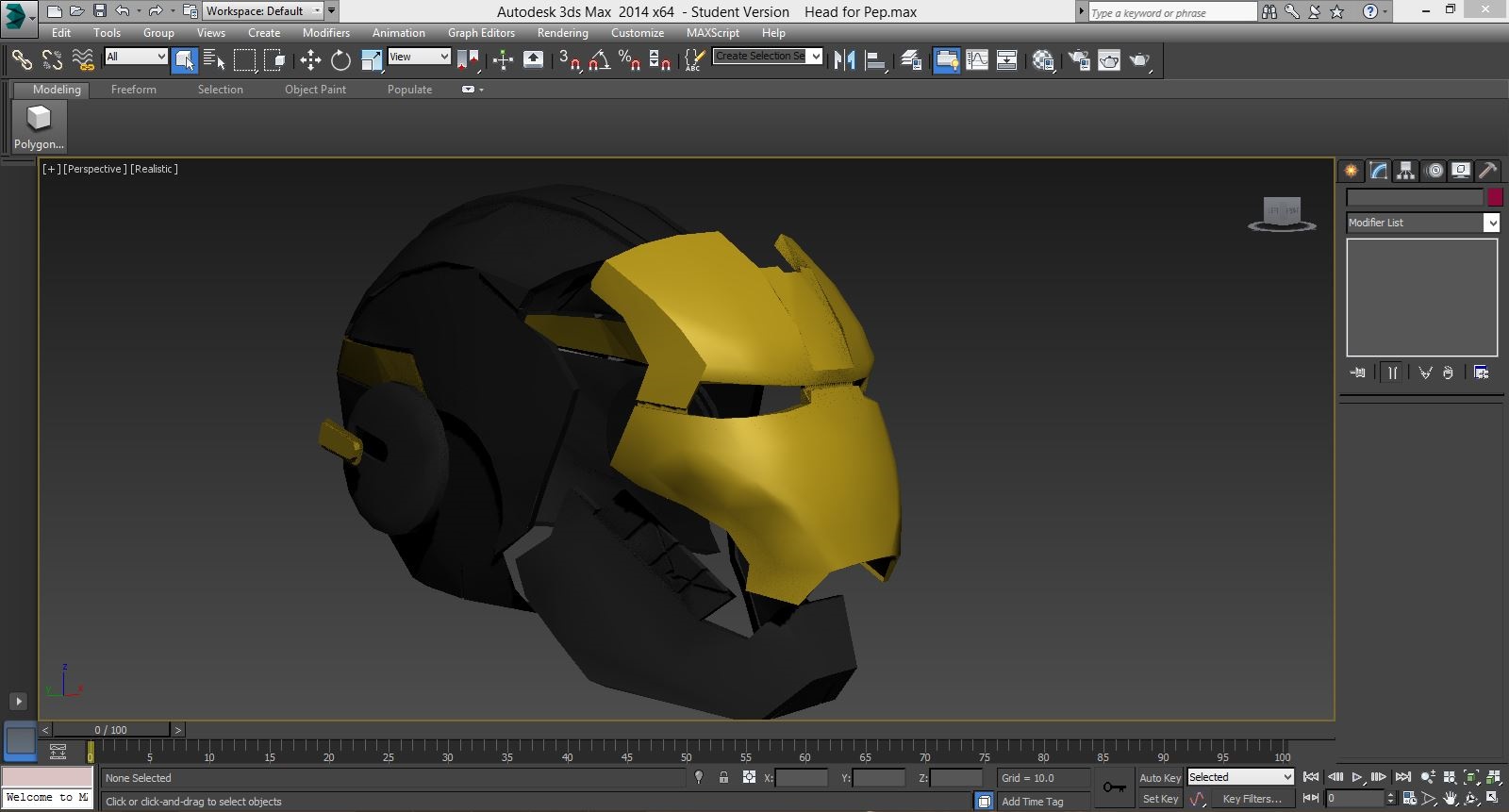
Sheldon Gilman: “Files to create an Iron Man suit are all available through various forums like The 405th and the RPF Forum, and even through Facebook groups. However, you need to be familiar with a program called Pepakura to access these files. Pepakura is a paper modelling program. Essentially, it will take a 3d file and lay it out flat on an A4 sheet for you to cut out and glue together. It is much like the UVW unfold feature in 3DS Max (if you are familiar with that), with the added function of being able to print what you have unfolded.  Below are pictures of the helmet I designed in 3DS Max, then imported and unfolded in Pepakura.”
image

3DS Max 2013

image

Pepakura Designer 3

“On my first attempt, I made the helmet out of foam. My thinking was to cover the helmet in latex rubber, then plaster to make a reusable mould. There are some great tutorials on how to do this process on YouTube. However, my first attempt turned out to be quite costly and failed spectacularly.”

image

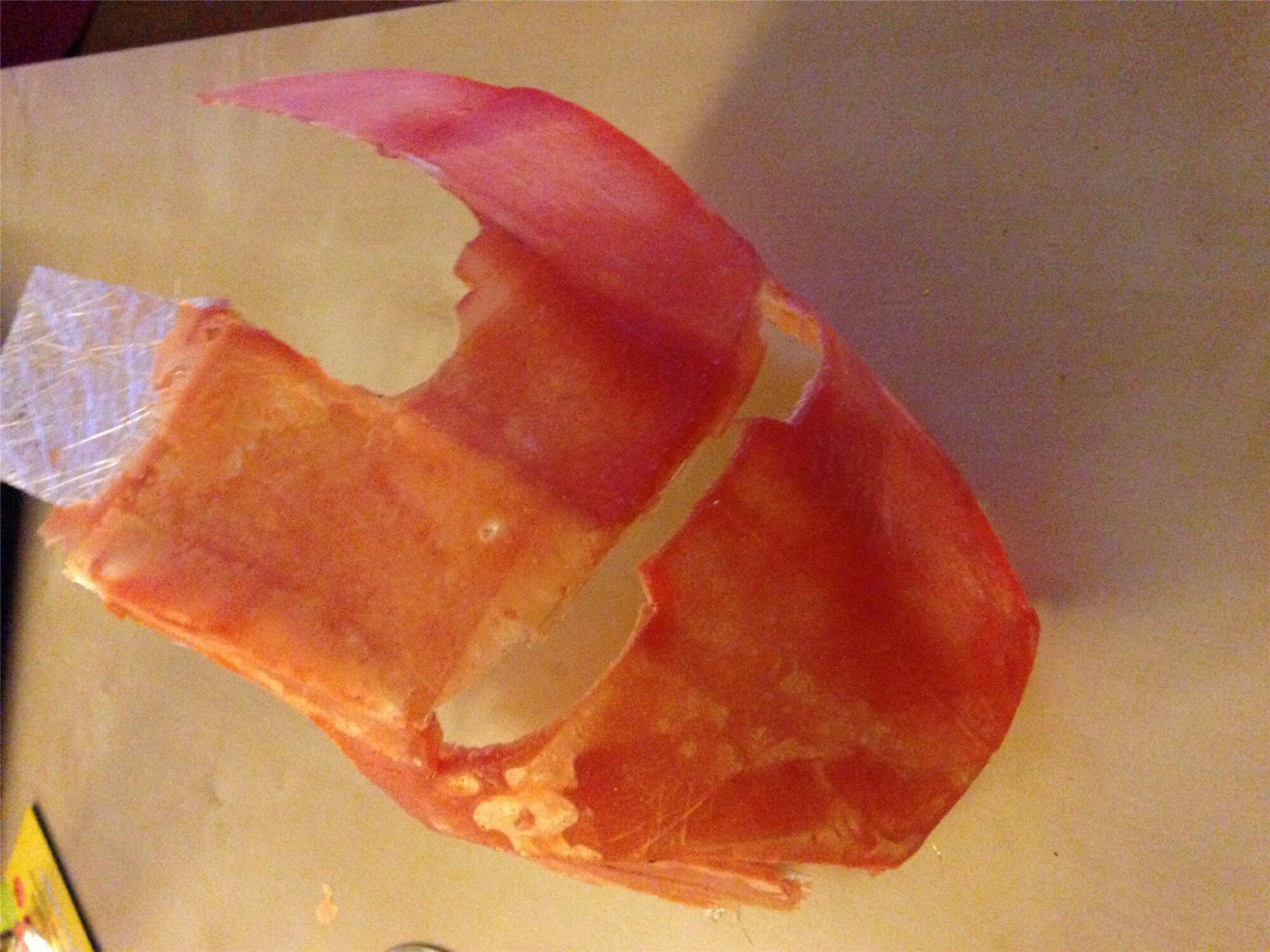
“The mould was flaky and crumbling when it was handled, when I put fibreglass on the inside of the mould there were huge air bubbles, and the latex mould was too thin, which meant that whenever I added fibreglass to the inside, it kept collapsing in on itself.  Worse yet, even though I was doing it outside, the smell was quite potent and lingered for about a day or two, which wasn’t good around my one year old daughter. Due to all of that, that idea was abandoned for the next method, and I went down the cardstock route.”
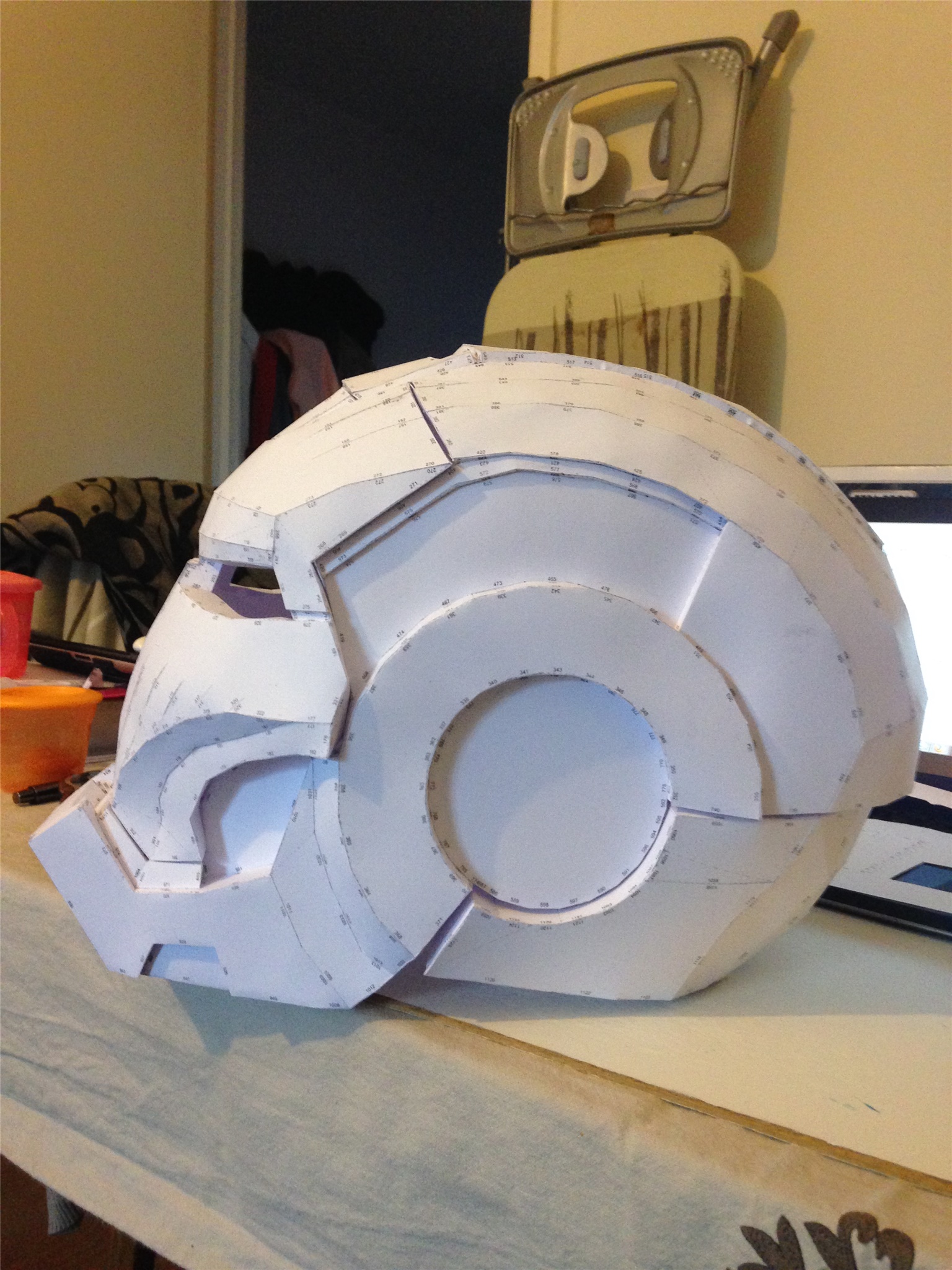
image

image

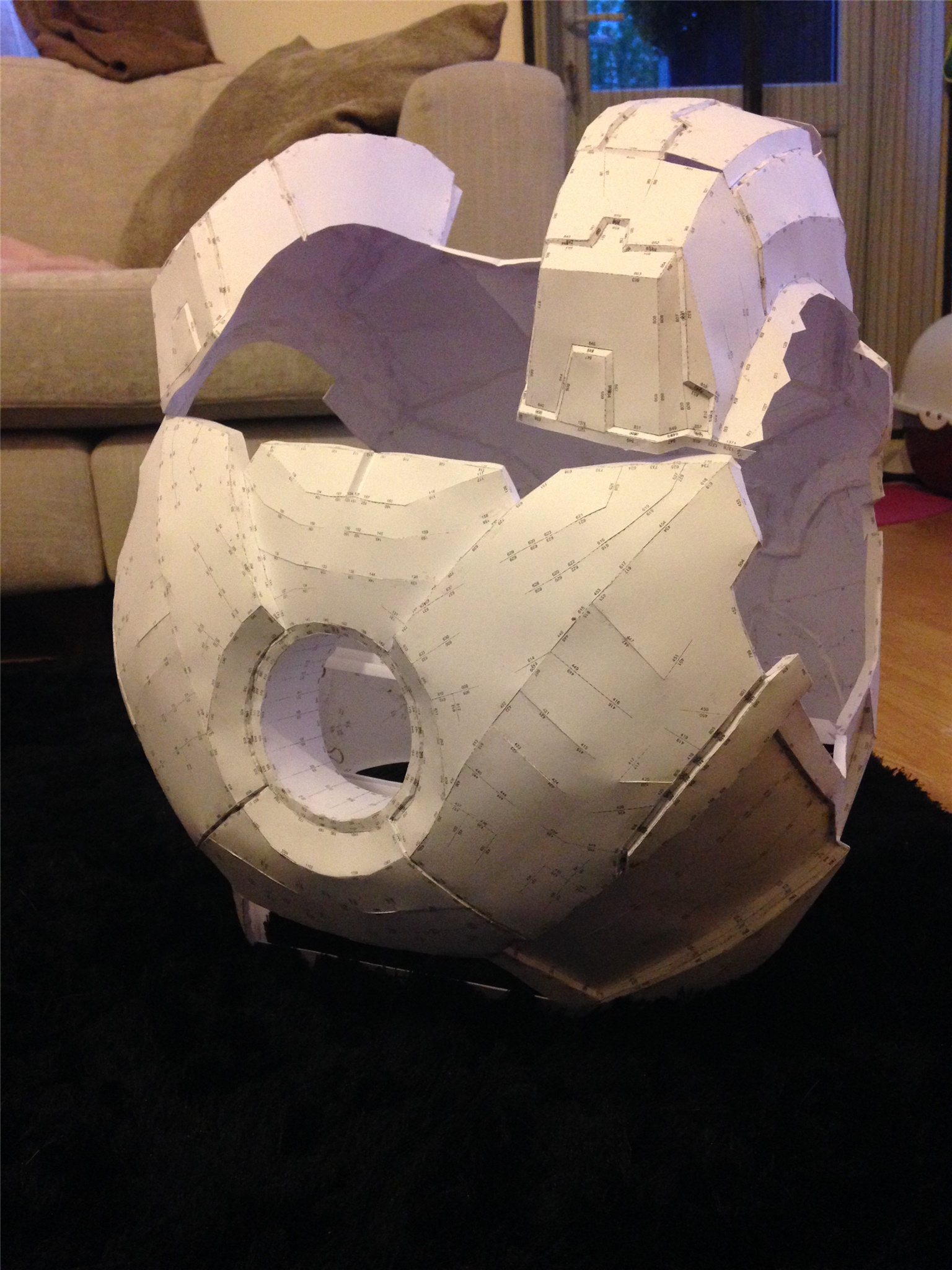
“This process involves printing the parts out from Pepakura onto cardstock, cutting them out with a craft knife, and glueing them together. While this at time was mind-numbingly boring, with all of those teeny tiny intricate pieces, overall, it is great fun seeing your work slowly come to life.”

“Next, the part will need to be covered with fibreglass resin both inside and out. This gives the part more rigidity. Then, the fibreglass can be added to the inside. Bondo or car body filler is applied to the outside to fill in any imperfections, and then sanded down to make it smooth. Primer is applied and, lastly, paint.”

“If you would like a more in-depth tutorial on how to do this process, please take a look at Boochieboy’s youtube channel. Evil Ted Smith also has some useful videos on how to build costumes using foam.”

“I am now making the parts out of 160g card stock. Many people wonder, “why not just make it out of normal printer paper?” That would be a big no no!  For this process to succeed, the parts need to be made from card stock as it is thicker and can absorb fibreglass resin with minimal warpage.”
image

Iron Man Mk20 Chest and Back                                  

image

War Machine Chest and Back

image

Iron Man Mk20 Helmet                                                  

image

War Machine Helmet

“As I mentioned, the parts will need to be covered both inside and out in fibreglass resin. This helps make it more rigid before applying the fibreglass. Once all the fibreglass is on, the part will be rock hard.”

“If you have never worked with fibreglass resin before, it comes in two parts: the resin and the hardener. Once the hardener is added to the resin, you have a very short window of opportunity to apply it to your project; roughly three to five mins depending on if you’ve mixed it right.”

“An unfortunate drawback to this method is once you’ve used a paintbrush, it can never be used again as the resin will solidify within a matter of minutes and make the brush rock solid, and there is no way I know of to clean a brush off so this means I have to buy paintbrushes in bulk. However, it’s not too bad as I get about twenty-four 12mm brushes for about £6 from eBay.”

Further details of Sheldon’s project will follow on the Train2Game blog.

Train2Game News BBC micro:bit

image

The BBC and partners today unveiled the BBC micro:bit – a pocket-sized, codeable computer that allows children to get creative with technology. In the BBC’s most ambitious education initiative for 30 years, up to 1 million devices will be given to every 11 or 12 year old child in year 7 or equivalent across the UK, for free.

In the 1980s, the BBC Micro introduced many children to computing for the first time. Part of the BBC’s 2015 Make it Digital initiative, the BBC micro:bit builds on the legacy of the Micro for the digital age, and aims to inspire young people to get creative with digital; develop core skills in science, technology and engineering; and unleash a new generation of digital makers, inventors and pioneers.

The UK currently faces a critical skills shortage in the technology sector, and the BBC and our partners aim to help change that.

Tony Hall, Director-General of the BBC says: “Channelling the spirit of the Micro for the digital age, the BBC micro:bit will inspire a new generation in a defining moment for digital creativity here in the UK. All you need is your curiosity, creativity and imagination – we’ll provide the tools. This has the power to be transformative for the UK. The BBC is one of the few organisations in the world that could convene something on this scale, with such an unprecedented partnership at its core.”

The BBC micro:bit is a pocket-sized computer that you can code, customise and control to bring your digital ideas, games and apps to life. It measures 4cm by 5cm, will be available in a range of colours, and is designed to be fun and easy to use. Something simple can be coded in seconds – like lighting up its LEDs or displaying a pattern – with no prior knowledge of computing. All that’s needed is imagination and creativity.

The BBC micro:bit also connects to other devices, sensors, kits and objects, and is a great companion to Arduino, Galileo, Kano, littleBits and Raspberry Pi, acting as a spring-board to more complex learning.

Key features include:

    25 red LEDs to light up, flash messages, create games and invent digital stories

    Two programmable buttons activated when pressed. Use the micro:bit as a games controller. Pause or skip songs on a playlist.

    On-board motion detector or ‘accelerometer’ that can detect movement and tell other devices you’re on the go. Featured actions include shake, tilt and freefall. Turn the micro:bit into a spirit level. Light it up when something is moved. Use it for motion-activated games.

    A built-in compass or ‘magnetometer’ to sense which direction you’re facing, your movement in degrees, and where you are. Includes an in-built magnet, and can sense certain types of metal.

    Bluetooth Smart Technology to connect to the internet and interact with the world around you. Connect the micro:bit to other micro:bits, devices, kits, phones, tablets, cameras and everyday objects all around. Share creations or join forces to create multi-micro:bit masterpieces. Take a selfie. Pause a DVD or control your playlist. 

    Five Input and Output (I/O) rings to connect the micro:bit to devices or sensors using crocodile clips or 4mm banana plugs. Use the micro:bit to send commands to and from the rings, to power devices like robots and motors.

Each element of the BBC micro:bit is completely programmable via easy-to-use software on a dedicated website (available later in the summer at microbit.co.uk) that can be accessed from a PC, tablet or mobile. Your personal area on the website will allow you to save and test your creations in a simulator before they are transferred to your micro:bit, and the available tools scale to be as complex as your ideas, imagination and skills require.

Sinead Rocks, Head of BBC Learning, says: “We happily give children paint brushes when they’re young, with no experience – it should be exactly the same with technology. The BBC micro:bit is all about young people learning to express themselves digitally, and it’s their device to own. It’s our most ambitious education initiative for 30 years. And as the micro:bit is able to connect to everything from mobile phones to plant pots and Raspberry Pis, this could be for the internet-of-things what the BBC Micro was to the British gaming industry.”

The micro:bit was first conceived by BBC Learning in 2012, and initially developed together with the BBC’s award-winning R&D department. The scale and scope of this unique initiative has only been made possible by an unprecedented collaboration between 29 international organisations, pioneering start-ups and transformative education organisations.

The BBC is the overall editorial and project lead for the micro:bit, coordinating the partnership, micro:bit development and delivery, learning resources and on-air and online inspiration for teachers, schools and makers across the UK.

Product partners include:

    ARM – providing mbed hardware, software development kits and compiler services
    Barclays – supporting overall product delivery and outreach activities
    element14 – sourcing components and managing the manufacturing
    Freescale – supplying the sensors and USB controllers
    Lancaster University – creating and writing the micro:bit runtime
    Microsoft – providing the TouchDevelop web-based programming tools and hosting service as well as teacher-training materials
    Nordic Semiconductor – supplying the main processor and enabled Bluetooth Smart
    Samsung – connecting the BBC micro:bit to phones and tablets, and developing the Android app
    ScienceScope – distributing to schools and developing the iOS app
    Technology Will Save Us – designing the shape, look and feel of the device
    The Wellcome Trust – providing learning opportunities for teachers and schools

Fundamental to the success of the BBC micro:bit, the BBC and partners will be working closely with teachers, educators and schools over the summer to ensure that resources, information and support are available in advance of micro:bit distribution this autumn, supporting the curriculum. BBC Learning will also provide resources including Live Lessons, getting started videos, projects and tutorials.

The BBC micro:bit will start to arrive in schools in late October, giving children a chance to settle into new schools, and teachers the opportunity to build this into lesson plans for the rest of the academic year.

The BBC micro:bit initiative aims to make a huge impact in 2015 with the BBC and its partners committed providing up to 1 million micro:bits before the end of the year. And it won’t stop there. The technical specifications for the device will be open-sourced, and the partnership plans to collectively develop a not-for-profit company to oversee and drive the micro:bit legacy. This will enable additional micro:bits to be made commercially available in the UK and internationally through various outlets in late 2015.

Source: http://www.bbc.co.uk/mediacentre/mediapacks/microbit

Train2Game News MineCon 2015 Record Winners

image

GUINNESS WORLD RECORDS, the global authority in record-breaking achievement presented MineCon with the Guinness World Records title Largest convention for a single video-game at MineCon 2015 and eight new titles were achieved at the  GWR Live! stand.

The first batch of tickets to MineCon 2015, were sold out within 12 minutes and the full allocation of 10,000 soon afterwards in March this year. The first MineCon in 2011 was attended by just 200 people and just like the game; its success has been meteoric with tickets now earning diamond ore status!

Guinness World Records brought the GWR Live! experience to MineCon 2015 where gamers could take part in the hourly live official record attempts. Over 1000 young gamers visited the stand and eight new Guinness World Records titles were achieved in physical attempts and on Minecraft pocket edition.

13 year old Jake Edwards achieved The most sand castles built in 3 minutes on minecraft pocket edition, creating 14 sandcastles and 12 year old Omar Siraj managed The most cobblestone collected in 3 minutes on minecraft pocket edition, collecting 137 cobblestonesl

Brothers Adrian and Darren Mo walked away with the Guinness World Record title for ‘Most soft toys caught blindfolded in 30 seconds (team of 2)’, managing to catch an impressive 11 Minecraft toys.

No one was able to break the record  for the  fastest time to stack 20 large LEGO bricks but there were some very close misses and the enthusiasm and dedication from the gamers  and excitement on taking part in actual live record attempts more than made up for it!

Lydia Winters, Brand Director at Mojang was excited to receive the Guinness World Records title and accepted the official certificate at the exciting opening ceremony.

Stephen Daultrey Editor of Guinness World Records Gamer’s Edition said ‘For a multi-genre games convention to attract 10,000 fans is a big enough feat in itself. But for a convention dedicated to a single video-game to get that number is nothing short of astonishing. This record is testament to the incredible fandom around Minecraft and the game’s ability to unlock the imaginations of millions of gamers around the world.’

A must-have for all gamers the GUINNESS WORLD RECORDS Gamer’s Edition 2016 is available on 10 September 2015, £9.99 RRP.

Train2Game News UK Top 20 Games – 06.07.15

wpid-batman-arkham-knight-gets-stellar-gotham-is-mine-gameplay-video.jpgAfter several new games last week this weeks charts sees no new blood. The Caped Crusader remains at number one with Arkham Knight.

All formats

Week ending 4 July 2015

POS.  TITLE  PUBLISHER  LAST
WEEK 
1 BATMAN: ARKHAM KNIGHT WARNER BROS. INTERACTIVE 1
2 LEGO JURASSIC WORLD WARNER BROS. INTERACTIVE 2
3 THE ELDER SCROLLS ONLINE BETHESDA SOFTWORKS 3
4 THE WITCHER III: WILD HUNT BANDAI NAMCO ENTERTAINMENT 5
5 GRAND THEFT AUTO V ROCKSTAR 6
6 YOSHI’S WOOLLY WORLD NINTENDO 4
7 MINECRAFT: XBOX EDITION MICROSOFT 11
8 FIFA 15 EA SPORTS 8
9 CALL OF DUTY: ADVANCED WARFARE ACTIVISION 7
10 MINECRAFT: PLAYSTATION EDITION SONY COMPUTER ENT. 12
11 DESTINY ACTIVISION 9
12 DYING LIGHT WARNER BROS. INTERACTIVE 16
13 PAYDAY 2: CRIMEWAVE EDITION 505 GAMES 14
14 FARMING SIMULATOR 15 FOCUS HOME INTERACTIVE 15
15 SPLATOON NINTENDO 19
16 HALO: THE MASTER CHIEF COLLECTION MICROSOFT 17
17 FAR CRY 4 UBISOFT
18 MOTOGP 15 MILESTONE 13
19 TERRARIA XBOX 360 CLASSICS 20
20 MORTAL KOMBAT X WARNER BROS. INTERACTIVE 18
< previous week
Leisure software charts compiled by Chart Track, (C)2015 UKIE Ltd

These charts cannot be reproduced either in print or online without obtaining permission from Ukie. If you wish to reproduce the charts in print or online, please contact david.smith@ukie.org.uk for the appropriate license.

Train2Game News Videogame Nation Season Three

image

Smash show Videogame Nation produced by Ginx TV has been commissioned for a third series, set to premiere tomorrow onChallenge on Saturday July 4th , 10 AM.

The show will see the return of gaming journalists co-hosts  Dan Maher (Explosive Alan),  Aoife Wilson (Eurogamer) and  John Robertson (The Dark Room) celebrating games, gamers and gaming culture. Featuring one major gaming release per week, the successful series is a blend of reviews, conversation, comedy and Top 5 picks.

As a show made by gamers for gamers, the new series renews its commitment to inclusivity and challenges the viewers’ perception of video games by exploring the world of gaming culture, from the understated beauty of games such as  Everybody’s Gone to the Rapture  to the super-powered open world of Batman: Arkham Knight.

This season will feature global gaming phenomenon including the galactic saga Star Wars: Battlefront, the anticipated apocalyptic frenzy of  Fallout 4, and the return of Lara Croft in  Rise of the Tomb Raider, as well as lesser-known indie gems such as Mike Bithell’s  Volume.

High-profile names in the new series include The Guardian’s Games Editor Keith Stuart, Kotaku’s UK Editor  Keza MacDonald, PCGamesN’s  Steve Hogarty, presenter  Julia Hardy (Video Game BAFTAs), and comedians  Steve McNeil (Go 8-bit) and  Ellie Gibson (Scummy Mummies).

Ginx TV’s Creative Director and Executive Producer  James Neal commented: “We are really excited that Challenge is committed to bringing video game entertainment to broadcast television for British audiences. The latter part of 2015 is stacked with the most amazing slate of video game launches on next gen consoles and PC and Videogame Nation will be perfectly placed to maximise the opportunity for TV.” 

Stephen Ladlow,  Director of Challenge commented:  “With such an array of eagerly anticipated games launching this year, it’s an exciting time in the world of gaming. Here at Challenge, with this new series of Videogame Nation, we are aiming to indulge our viewers and gamers in the latest topics, reviews, and hottest developments in gaming culture. 
Videogame Nation will be Produced and Directed by Ginx TV’s  Adam Mason and was commissioned by Director of Challenge and Pick TV,  Stephen Ladlow.

The brand new season 3 of Videogame Nation starts on Saturday July 4th at 10am on Challenge (Sky 145, Freeview 46, Freesat 145, Virgin 139) in the UK, and every Monday from July 20th at 19:00 CET on GINX TV.

Train2Game News Streaming software available for public

image

SplitmediaLabs Limited (“SplitmediaLabs”) are thrilled to reveal that they will be teaming up with GAME as a retail partner to provide the public with their industry standard live-streaming software.

The partnership will allow consumers to gain access to one of the industry’s best live streaming software platforms empowering the public to have a voice and paving the way for new talent to emerge.

Starting today, 2nd July 2015, the retail giant GAME will be selling personal license fees for the XSplit broadcasting platform with 1 month vouchers retailing at £5 and 6 months at a discounted £25.

“This partnership creates a unique retail opportunity for XSplit to engage with the public” says John Howe Marshall, Global P.R & Marketing Coordinator at SplitmediaLabs.

“Anybody can now walk into one of the hundreds of GAME stores across the country, or browse their site online and have the opportunity to join the new talent that is building the live streaming phenomenon into one of the most exciting communities around”

Those who have purchased a personal license can gain access to the XSplit Broadcaster and Gamecaster with enhanced features, superior audio support and full HD broadcasting at 60fps and beyond.

Train2Game News Ed Vaizey at Develop Conference

image

Tandem Events, organisers of Europe’s leading video games developer conference Develop:Brighton, announced Minster for Culture and the Digital Economy, Ed Vaizey MP, will address attendees on Wednesday 15 July.

Speaking directly after the opening keynote at 10.30am, Vaizey MP will deliver a speech on his department’s outlook for the video games industry in the United Kingdom.

Ed Vaizey MP first attended Develop:Brighton in 2010 and will look back on what has changed in terms of policy over that time period, how tax credits will affect the industry and his ambition for the next five year while in office.

Appointed Minister of State at the Department for Culture, Media and Sport and the Department for Business, Innovation and Skills, with responsibility for digital industries on 15 July 2014, Ed Vaizey MP was first elected as the MP for Wantage in 2005. He was re-elected in 2010, and May 7 2015.

“We are delighted to welcome back Ed Vaizey MP to Develop:Brighton,” commented Andy Lane, managing director of Tandem Events. “It’s fantastic the Minister continues to champion the video games industry in the UK and that he’s chosen to deliver his address here at Develop:Brighton once again.”

Registration is open at www.developconference.com with passes starting from as little as £125. Entry to the Expo is free.

Train2Game News Student creating Iron Man Suit

image

Train2Game student Sheldon Gilman is a huge fan of Iron Man and he’s decided to make it his mission to create the ultimate replica Iron Man suit.

Sheldon has kindly agreed to document his build and has agreed to document his suit creation journey in a series of Train2Game blogs entries. This is Sheldon’s second attempt at the ultimate suit.

In this first blog piece Sheldon gives some detail of what he’s working on and what he’s created in the past. As you will find out, he’s got some pretty grand plans for his second design.
                    
“About two years ago, I had the idea to make a wearable Iron Man suit for Comic-Con. I had lots of fun building it and decided I wanted to do it again with some major improvements as my first attempt was very basic.”

“My first suit I made was the Mark 7. It was made out of high density foam and it took me approximately six months to build; however, I was not satisfied with the result. The foam acted as insulation and got very hot very quickly and, without a helmet with an opening faceplate, it quickly became uncomfortable to wear.”

“So, ever the perfectionist, I vowed to make a better suit. The materials would be more suited to the job and I would design some of the parts myself. There are already many versions of the iron man suit available on the web, They are all free for anyone to download and require a minimal knowledge of 3D design to understand the plans and use the program Pepakura. It also requires a creative and patient mind to put it all together and make the parts fit comfortably.”

“So after much research and deliberation, I decided to attempt to build both an Iron Man Mark 20 (Mk 20 code name: Python) and a War Machine suit.”
        
“I chose to make the Mk20 mainly because I loved the colours. The black and gold seemed to work really well in pictures I found on the web and on the hottoys website. Elements of the suit were already available. Many people are unaware that most of the iron man suits have parts that are interchangeable e.g. the Mk20 is made up of the Mk7 and Mk17.

There are minor changes on it that make it unique but essentially, it is just these two suits amalgamated into one. The minor changes are on things like the helmet and the upper chest and neck pieces. These parts I will be attempting to make myself.”

“Both suits will be made mainly from fibreglass but will also have 3D printed parts as well as foam parts for comfort.”

“The helmet itself will be a vast improvement on my first one. While the first one was made of foam, extremely hot and wouldn’t open, the new one will open and close with the help of servos, and a micro controller mounted to the top of the helmet.”

“The eyes will turn on and off and will be made from electroluminescent panels , it will also house a tiny pinhole camera (aprox. 1cm x 1cm) and this will be connected to two tiny screens on the inside of the visor taken from a Virtual Reality visor.

“It will also have a fan inside taken from old PCs I had around the house. Cooling is a must when you are walking around in your own personal oven. I am also toying with adding a voice modulator but I’m not sure yet. Any opinions on this would be really useful to me.

“I’m also thinking of adding Bluetooth headphones or earpiece in the helmets ear pod. As Sheldon from the Big Bang Theory says, “Everything is better with Bluetooth”. This would mean you could either listen to music from your phone or use the hands free function on your Smartphone without having to take the helmet off to answer your phone. If this idea fails drastically, I can always come back to my idea to add a motorcycle helmet walkie-talkie so the Mk 20 can talk to the War Machine suit.”

“Most of this will require electronic project kits from places like Adafruit.com and Sparkfun. These kits are for people who want to make their own circuit boards and are a fun way to get into soldering components onto PCB boards. The kits come in all shapes and sizes and perform a variety of tasks from turning lights on and off and activating servos to creating GPS receivers and robots follow the links if you wish to learn more about that. As you can see from what I’ve written so far, I sure do love to challenge myself lol.”

“As for the rest of the suit, I will be adding moving flaps (flight stabilisers) to the back of both suits. They will also both have working Arc reactors (the light in the middle of the chest), 3D printed gloves, and working hand repulses (light on the palm of the hand).”

“The War Machine suit will also “hopefully” have a shoulder mounted gun that will move up, down, left, and right depending on where the person is looking. This will be controlled by an accelerometer in the helmet but more on that at a later stage in the build.”

“In the next instalment, I will cover the software I used, the design and test phase. I will also be showing you what I’ve done so far, the fibreglass and foam build process as well as my failures.”

“Comments, questions, and suggestions are also most welcome.”

Train2Game News Open Gaming Alliance’s new member

image

The Open Gaming Alliance (OGA), a non-profit trade association focused on the games industry, today announced Lenovo, the world’s number one PC maker, as the latest company to become a corporate member.

Lenovo joins other industry leading companies including  Intel,  Dell/Alienware,  Logitech,  Razer,  Unity and  Webroot in supporting the OGA’s efforts to provide leadership and opportunities; and encourage growth and diversity within the games business ecosystem.

The  Open Gaming Alliance recently released its annual  Pinnacle research report analyzing industry revenues and trends. Leading into this year’s E3 Expo, the organization also  announced several new initiatives including new  membership levels; new AR/VR, Software and Cloud Gaming special interest groups; and a significant expansion of its indie developer support.

“As gamers continue to drive PC growth around the world, we are excited to join OGA’s gaming ecosystem to identify opportunities and best practices with other industry developers and influencers,” said Dilip Bhatia, vice president, WW Marketing, PC and Enterprise Group, Lenovo. “This fall, we will be bringing to consumers an exciting new series of premium gaming desktops and laptops that will take PC gaming to the next level.”

The Open Gaming Alliance provides an array of resources to its industry members, ranging from research and best-practice guidance; to marketing support and networking with some of the industry’s premier middleware and hardware providers, and publishers. Originally established in 2008 as the PC Gaming Alliance, the organization has evolved to cover multiple platforms and operating systems; maintaining its primary goals of strengthening and promoting the community around all game platforms while providing a unified voice.

“Lenovo is the leading provider of personal PCs, and the biggest provider of mobile phones in the important China market,” said  Drew Johnston, OGA president. “You can’t talk about either as a gaming platform without including them. We look forward to the valuable insight they bring to the table, and their help in delivering the best knowledge and guidance for our members to be successful.”

Train2Game News Tenshi Grants

image

Tenshi Grants today announces that games industry consultant Ella Romanos will lead the expansion of their Tenshi Grants service, which helps companies to access grant funding.

Tenshi Grants works specifically within the games and digital sectors, offering support for applications for UK and EU grants, including InnovateUK SMART grants and Horizon 2020 EU grants. The team are all experienced in the industry and in running their own businesses, which gives them a unique ability to understand what companies need, as well as having a proven track record in successfully winning grants.

“Tenshi Grants has a great legacy of successfully supporting developers with grant funding applications, which gives me a great opportunity to work with the team to expand their offering and help a larger number of companies in games and digital” says Ella Romanos.

“Ella joins us as an experienced games industry consultant and developer. By combining Tenshi’s track record and depth of knowledge with Ella’s experience in growing and assisting small and medium sized digital businesses, we can offer significant added value to our customers and the industry.” says Ian Baverstock, Tenshi Director

Tenshi Grants has to date helped companies such as Coatsink, Whispering Gibbon and Brightbook, and works with all types of companies, from startups to larger more established teams.

To discuss if there might be grants available for your company, please contact Ella on grants@tenshi.co.uk or visit www.tenshigrants.com.