Train2Game News Iron Man Costume part 2

image

Train2Game student Sheldon Gilman has made it his mission to create the ultimate Iron Man suit. He also has plans to create more suits from the popular Iron Man series of films.

He’s recording his journey in creating these wonderful creations via the Train2Game blog.   Posting updates on his own creations while giving advice to other aspiring costume makers.

In this latest entry to his blog, he discusses software used to create his design, mould creation and some of the setbacks he has encountered.

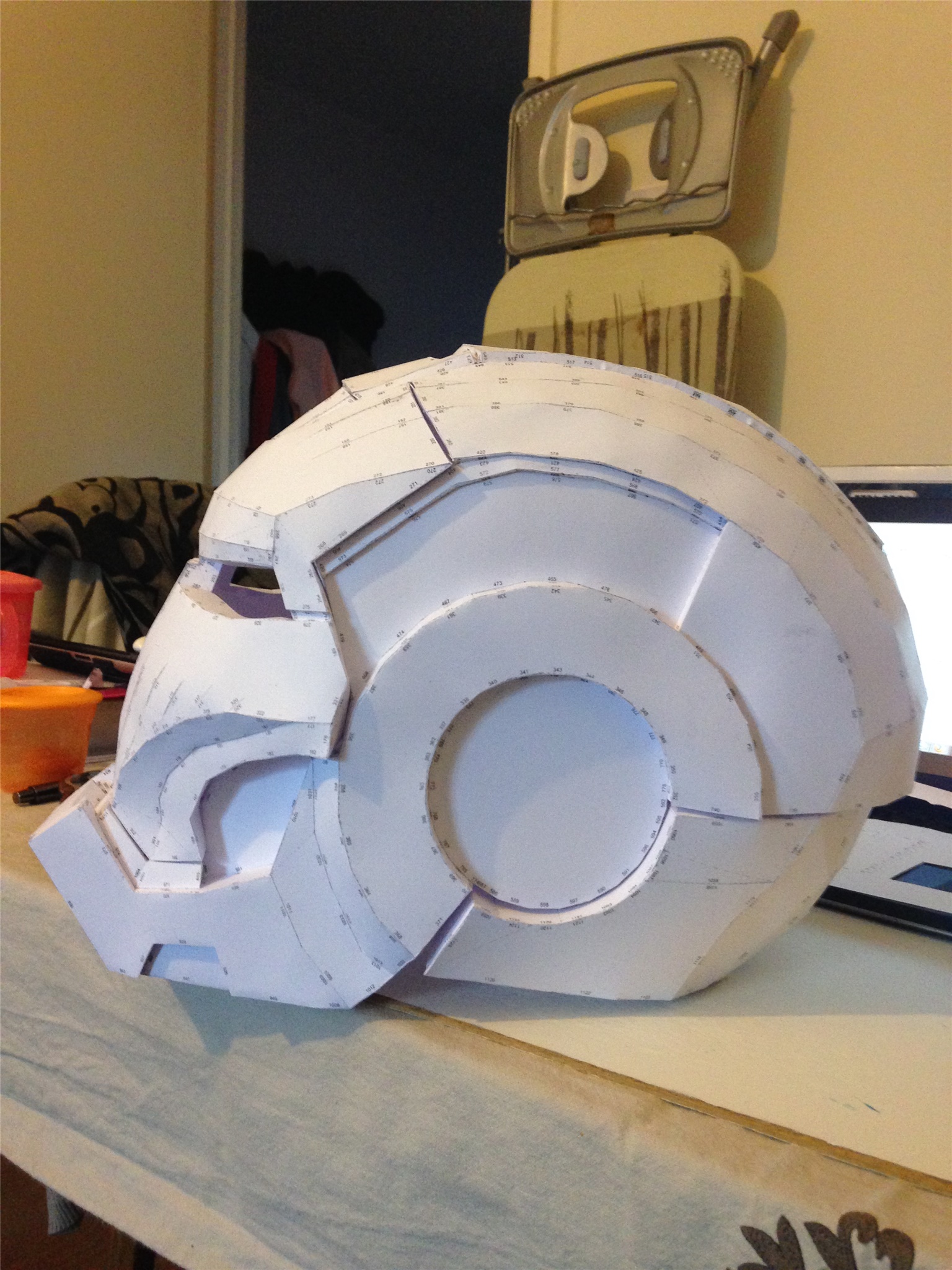
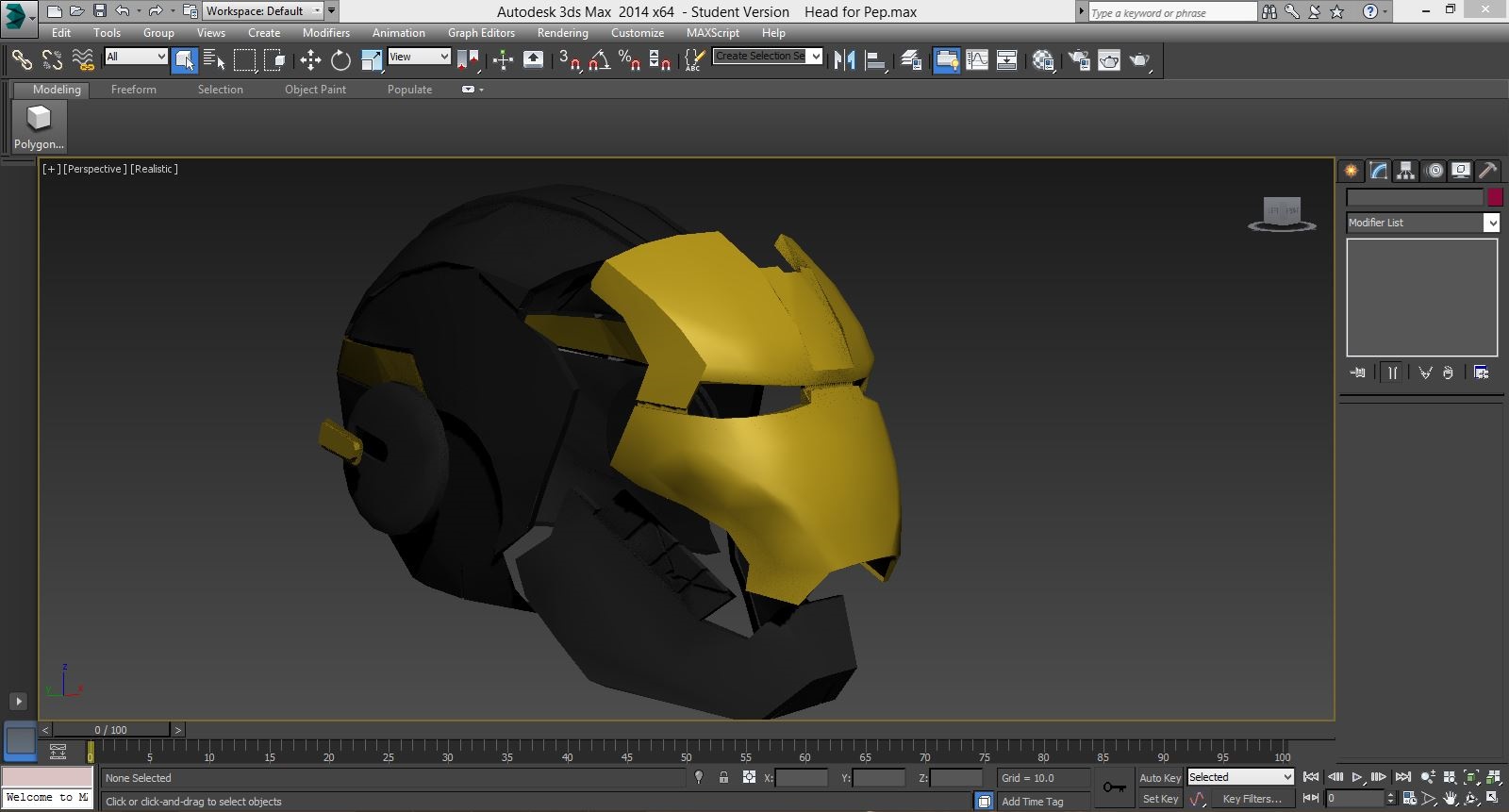
Sheldon Gilman: “Files to create an Iron Man suit are all available through various forums like The 405th and the RPF Forum, and even through Facebook groups. However, you need to be familiar with a program called Pepakura to access these files. Pepakura is a paper modelling program. Essentially, it will take a 3d file and lay it out flat on an A4 sheet for you to cut out and glue together. It is much like the UVW unfold feature in 3DS Max (if you are familiar with that), with the added function of being able to print what you have unfolded.  Below are pictures of the helmet I designed in 3DS Max, then imported and unfolded in Pepakura.”
image

3DS Max 2013

image

Pepakura Designer 3

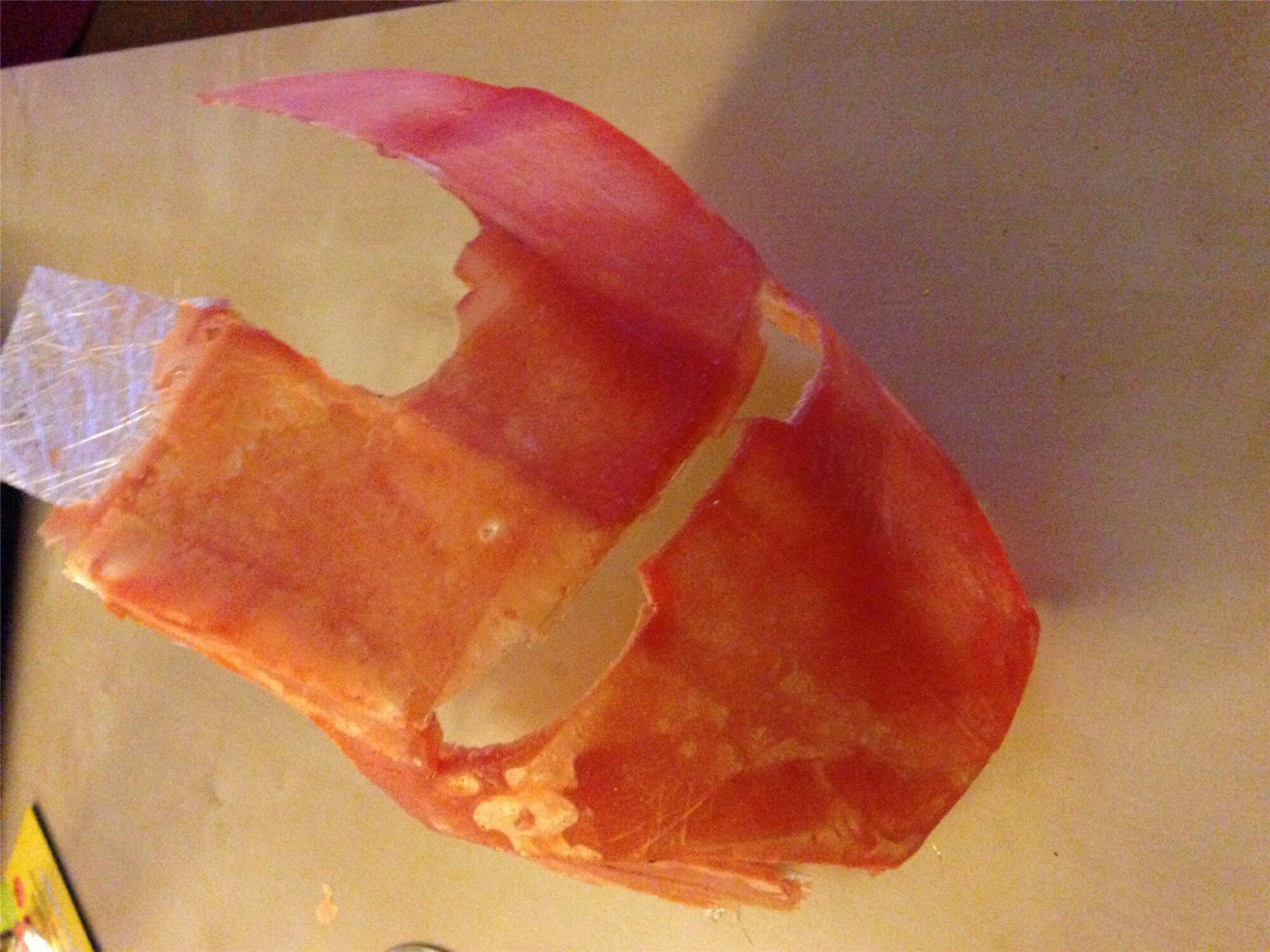
“On my first attempt, I made the helmet out of foam. My thinking was to cover the helmet in latex rubber, then plaster to make a reusable mould. There are some great tutorials on how to do this process on YouTube. However, my first attempt turned out to be quite costly and failed spectacularly.”

image

“The mould was flaky and crumbling when it was handled, when I put fibreglass on the inside of the mould there were huge air bubbles, and the latex mould was too thin, which meant that whenever I added fibreglass to the inside, it kept collapsing in on itself.  Worse yet, even though I was doing it outside, the smell was quite potent and lingered for about a day or two, which wasn’t good around my one year old daughter. Due to all of that, that idea was abandoned for the next method, and I went down the cardstock route.”
image

image

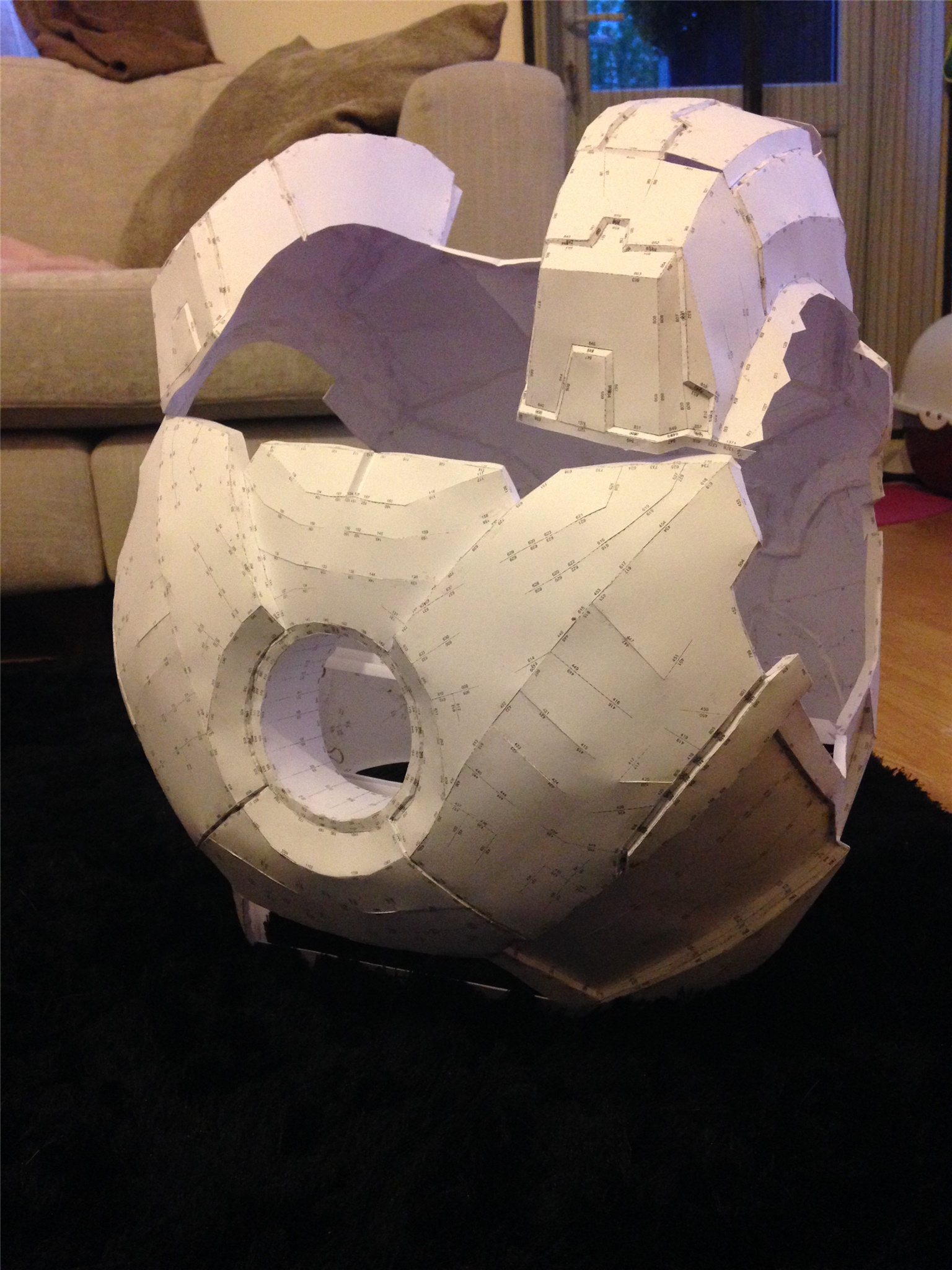
“This process involves printing the parts out from Pepakura onto cardstock, cutting them out with a craft knife, and glueing them together. While this at time was mind-numbingly boring, with all of those teeny tiny intricate pieces, overall, it is great fun seeing your work slowly come to life.”

“Next, the part will need to be covered with fibreglass resin both inside and out. This gives the part more rigidity. Then, the fibreglass can be added to the inside. Bondo or car body filler is applied to the outside to fill in any imperfections, and then sanded down to make it smooth. Primer is applied and, lastly, paint.”

“If you would like a more in-depth tutorial on how to do this process, please take a look at Boochieboy’s youtube channel. Evil Ted Smith also has some useful videos on how to build costumes using foam.”

“I am now making the parts out of 160g card stock. Many people wonder, “why not just make it out of normal printer paper?” That would be a big no no!  For this process to succeed, the parts need to be made from card stock as it is thicker and can absorb fibreglass resin with minimal warpage.”
image

Iron Man Mk20 Chest and Back                                  

image

War Machine Chest and Back

image

Iron Man Mk20 Helmet                                                  

image

War Machine Helmet

“As I mentioned, the parts will need to be covered both inside and out in fibreglass resin. This helps make it more rigid before applying the fibreglass. Once all the fibreglass is on, the part will be rock hard.”

“If you have never worked with fibreglass resin before, it comes in two parts: the resin and the hardener. Once the hardener is added to the resin, you have a very short window of opportunity to apply it to your project; roughly three to five mins depending on if you’ve mixed it right.”

“An unfortunate drawback to this method is once you’ve used a paintbrush, it can never be used again as the resin will solidify within a matter of minutes and make the brush rock solid, and there is no way I know of to clean a brush off so this means I have to buy paintbrushes in bulk. However, it’s not too bad as I get about twenty-four 12mm brushes for about £6 from eBay.”

Further details of Sheldon’s project will follow on the Train2Game blog.

Train2Game News BBC micro:bit

image

The BBC and partners today unveiled the BBC micro:bit – a pocket-sized, codeable computer that allows children to get creative with technology. In the BBC’s most ambitious education initiative for 30 years, up to 1 million devices will be given to every 11 or 12 year old child in year 7 or equivalent across the UK, for free.

In the 1980s, the BBC Micro introduced many children to computing for the first time. Part of the BBC’s 2015 Make it Digital initiative, the BBC micro:bit builds on the legacy of the Micro for the digital age, and aims to inspire young people to get creative with digital; develop core skills in science, technology and engineering; and unleash a new generation of digital makers, inventors and pioneers.

The UK currently faces a critical skills shortage in the technology sector, and the BBC and our partners aim to help change that.

Tony Hall, Director-General of the BBC says: “Channelling the spirit of the Micro for the digital age, the BBC micro:bit will inspire a new generation in a defining moment for digital creativity here in the UK. All you need is your curiosity, creativity and imagination – we’ll provide the tools. This has the power to be transformative for the UK. The BBC is one of the few organisations in the world that could convene something on this scale, with such an unprecedented partnership at its core.”

The BBC micro:bit is a pocket-sized computer that you can code, customise and control to bring your digital ideas, games and apps to life. It measures 4cm by 5cm, will be available in a range of colours, and is designed to be fun and easy to use. Something simple can be coded in seconds – like lighting up its LEDs or displaying a pattern – with no prior knowledge of computing. All that’s needed is imagination and creativity.

The BBC micro:bit also connects to other devices, sensors, kits and objects, and is a great companion to Arduino, Galileo, Kano, littleBits and Raspberry Pi, acting as a spring-board to more complex learning.

Key features include:

    25 red LEDs to light up, flash messages, create games and invent digital stories

    Two programmable buttons activated when pressed. Use the micro:bit as a games controller. Pause or skip songs on a playlist.

    On-board motion detector or ‘accelerometer’ that can detect movement and tell other devices you’re on the go. Featured actions include shake, tilt and freefall. Turn the micro:bit into a spirit level. Light it up when something is moved. Use it for motion-activated games.

    A built-in compass or ‘magnetometer’ to sense which direction you’re facing, your movement in degrees, and where you are. Includes an in-built magnet, and can sense certain types of metal.

    Bluetooth Smart Technology to connect to the internet and interact with the world around you. Connect the micro:bit to other micro:bits, devices, kits, phones, tablets, cameras and everyday objects all around. Share creations or join forces to create multi-micro:bit masterpieces. Take a selfie. Pause a DVD or control your playlist. 

    Five Input and Output (I/O) rings to connect the micro:bit to devices or sensors using crocodile clips or 4mm banana plugs. Use the micro:bit to send commands to and from the rings, to power devices like robots and motors.

Each element of the BBC micro:bit is completely programmable via easy-to-use software on a dedicated website (available later in the summer at microbit.co.uk) that can be accessed from a PC, tablet or mobile. Your personal area on the website will allow you to save and test your creations in a simulator before they are transferred to your micro:bit, and the available tools scale to be as complex as your ideas, imagination and skills require.

Sinead Rocks, Head of BBC Learning, says: “We happily give children paint brushes when they’re young, with no experience – it should be exactly the same with technology. The BBC micro:bit is all about young people learning to express themselves digitally, and it’s their device to own. It’s our most ambitious education initiative for 30 years. And as the micro:bit is able to connect to everything from mobile phones to plant pots and Raspberry Pis, this could be for the internet-of-things what the BBC Micro was to the British gaming industry.”

The micro:bit was first conceived by BBC Learning in 2012, and initially developed together with the BBC’s award-winning R&D department. The scale and scope of this unique initiative has only been made possible by an unprecedented collaboration between 29 international organisations, pioneering start-ups and transformative education organisations.

The BBC is the overall editorial and project lead for the micro:bit, coordinating the partnership, micro:bit development and delivery, learning resources and on-air and online inspiration for teachers, schools and makers across the UK.

Product partners include:

    ARM – providing mbed hardware, software development kits and compiler services
    Barclays – supporting overall product delivery and outreach activities
    element14 – sourcing components and managing the manufacturing
    Freescale – supplying the sensors and USB controllers
    Lancaster University – creating and writing the micro:bit runtime
    Microsoft – providing the TouchDevelop web-based programming tools and hosting service as well as teacher-training materials
    Nordic Semiconductor – supplying the main processor and enabled Bluetooth Smart
    Samsung – connecting the BBC micro:bit to phones and tablets, and developing the Android app
    ScienceScope – distributing to schools and developing the iOS app
    Technology Will Save Us – designing the shape, look and feel of the device
    The Wellcome Trust – providing learning opportunities for teachers and schools

Fundamental to the success of the BBC micro:bit, the BBC and partners will be working closely with teachers, educators and schools over the summer to ensure that resources, information and support are available in advance of micro:bit distribution this autumn, supporting the curriculum. BBC Learning will also provide resources including Live Lessons, getting started videos, projects and tutorials.

The BBC micro:bit will start to arrive in schools in late October, giving children a chance to settle into new schools, and teachers the opportunity to build this into lesson plans for the rest of the academic year.

The BBC micro:bit initiative aims to make a huge impact in 2015 with the BBC and its partners committed providing up to 1 million micro:bits before the end of the year. And it won’t stop there. The technical specifications for the device will be open-sourced, and the partnership plans to collectively develop a not-for-profit company to oversee and drive the micro:bit legacy. This will enable additional micro:bits to be made commercially available in the UK and internationally through various outlets in late 2015.

Source: http://www.bbc.co.uk/mediacentre/mediapacks/microbit

Train2Game News Streaming software available for public

image

SplitmediaLabs Limited (“SplitmediaLabs”) are thrilled to reveal that they will be teaming up with GAME as a retail partner to provide the public with their industry standard live-streaming software.

The partnership will allow consumers to gain access to one of the industry’s best live streaming software platforms empowering the public to have a voice and paving the way for new talent to emerge.

Starting today, 2nd July 2015, the retail giant GAME will be selling personal license fees for the XSplit broadcasting platform with 1 month vouchers retailing at £5 and 6 months at a discounted £25.

“This partnership creates a unique retail opportunity for XSplit to engage with the public” says John Howe Marshall, Global P.R & Marketing Coordinator at SplitmediaLabs.

“Anybody can now walk into one of the hundreds of GAME stores across the country, or browse their site online and have the opportunity to join the new talent that is building the live streaming phenomenon into one of the most exciting communities around”

Those who have purchased a personal license can gain access to the XSplit Broadcaster and Gamecaster with enhanced features, superior audio support and full HD broadcasting at 60fps and beyond.

Train2Game News Student creating Iron Man Suit

image

Train2Game student Sheldon Gilman is a huge fan of Iron Man and he’s decided to make it his mission to create the ultimate replica Iron Man suit.

Sheldon has kindly agreed to document his build and has agreed to document his suit creation journey in a series of Train2Game blogs entries. This is Sheldon’s second attempt at the ultimate suit.

In this first blog piece Sheldon gives some detail of what he’s working on and what he’s created in the past. As you will find out, he’s got some pretty grand plans for his second design.
                    
“About two years ago, I had the idea to make a wearable Iron Man suit for Comic-Con. I had lots of fun building it and decided I wanted to do it again with some major improvements as my first attempt was very basic.”

“My first suit I made was the Mark 7. It was made out of high density foam and it took me approximately six months to build; however, I was not satisfied with the result. The foam acted as insulation and got very hot very quickly and, without a helmet with an opening faceplate, it quickly became uncomfortable to wear.”

“So, ever the perfectionist, I vowed to make a better suit. The materials would be more suited to the job and I would design some of the parts myself. There are already many versions of the iron man suit available on the web, They are all free for anyone to download and require a minimal knowledge of 3D design to understand the plans and use the program Pepakura. It also requires a creative and patient mind to put it all together and make the parts fit comfortably.”

“So after much research and deliberation, I decided to attempt to build both an Iron Man Mark 20 (Mk 20 code name: Python) and a War Machine suit.”
        
“I chose to make the Mk20 mainly because I loved the colours. The black and gold seemed to work really well in pictures I found on the web and on the hottoys website. Elements of the suit were already available. Many people are unaware that most of the iron man suits have parts that are interchangeable e.g. the Mk20 is made up of the Mk7 and Mk17.

There are minor changes on it that make it unique but essentially, it is just these two suits amalgamated into one. The minor changes are on things like the helmet and the upper chest and neck pieces. These parts I will be attempting to make myself.”

“Both suits will be made mainly from fibreglass but will also have 3D printed parts as well as foam parts for comfort.”

“The helmet itself will be a vast improvement on my first one. While the first one was made of foam, extremely hot and wouldn’t open, the new one will open and close with the help of servos, and a micro controller mounted to the top of the helmet.”

“The eyes will turn on and off and will be made from electroluminescent panels , it will also house a tiny pinhole camera (aprox. 1cm x 1cm) and this will be connected to two tiny screens on the inside of the visor taken from a Virtual Reality visor.

“It will also have a fan inside taken from old PCs I had around the house. Cooling is a must when you are walking around in your own personal oven. I am also toying with adding a voice modulator but I’m not sure yet. Any opinions on this would be really useful to me.

“I’m also thinking of adding Bluetooth headphones or earpiece in the helmets ear pod. As Sheldon from the Big Bang Theory says, “Everything is better with Bluetooth”. This would mean you could either listen to music from your phone or use the hands free function on your Smartphone without having to take the helmet off to answer your phone. If this idea fails drastically, I can always come back to my idea to add a motorcycle helmet walkie-talkie so the Mk 20 can talk to the War Machine suit.”

“Most of this will require electronic project kits from places like Adafruit.com and Sparkfun. These kits are for people who want to make their own circuit boards and are a fun way to get into soldering components onto PCB boards. The kits come in all shapes and sizes and perform a variety of tasks from turning lights on and off and activating servos to creating GPS receivers and robots follow the links if you wish to learn more about that. As you can see from what I’ve written so far, I sure do love to challenge myself lol.”

“As for the rest of the suit, I will be adding moving flaps (flight stabilisers) to the back of both suits. They will also both have working Arc reactors (the light in the middle of the chest), 3D printed gloves, and working hand repulses (light on the palm of the hand).”

“The War Machine suit will also “hopefully” have a shoulder mounted gun that will move up, down, left, and right depending on where the person is looking. This will be controlled by an accelerometer in the helmet but more on that at a later stage in the build.”

“In the next instalment, I will cover the software I used, the design and test phase. I will also be showing you what I’ve done so far, the fibreglass and foam build process as well as my failures.”

“Comments, questions, and suggestions are also most welcome.”

Train2Game News Summer Video Game Book Bundle

image

Continuing its popular “pay what you want” ebook bundles, StoryBundle is proud to present the Summer Video Game Book Bundle – the sixth in the super popular series. Curated over the past 6 months, this specially picked set of 20+ fascinating game culture & history books/magazines.

It once again features over $100+ worth of books & magazines for a fraction of that price – including a world exclusive debut and literally thousands of pages of amazingly written and compiled content. This summer, either binge on the lot, or pick your favorites to read at your leisure!

The basic purchase tier ($3 or above) for the Summer Video Game Bundle, curated by game industry veteran Simon Carless, includes unprecdeented ‘behind the scenes’ development story ‘How Video Games Are Made’ by Russ Pitts, as well as the special multi-author Virtual Reality issue from the brains at Kill Screen Magazine.

Also available at this tier is the immensely entertaining ‘Boss Fight Books: Bible Adventures’ by Gabe Durham, exploring the odd story behind the even odder Christian NES games, plus ‘Put This In Your Brain’, a world exclusive to this Storybundle compiling some amazing writing from the first year of game culture pub Unwinnable Weekly.

The higher-tier rewards—available at the higher payment tier of $12 or your local equivalent—include ‘HG101 Presents An Unofficial Guide To Castlevania’ – Kurt Kalata & friends coming up trumps again on Konami’s seminal series, as well as the four-book series (!) revealing the fascinating history of the tabletop RPG, ‘Designers & Dragons – The ’70s, ’80s, ’90s, & ’00s’ by Shannon Appelcline.

In addition, you’ll get SCROLL #12 by Ray Barnholt, the final issue of the acclaimed game history magazine focusing on the MSX (plus SCROLL #1-#11 as a special bonus if you didn’t pick ’em up in a previous bundle!) – and finally, ‘The Untold History Of Japanese Game Developers, Vol. 1′ by John Szczepaniak, going super duper deep into the unknown past of Japanese game creation.

As always, StoryBundle lets you name your own price to get a whole bunch of epic and excellent titles. A minimum bid of $3 gets you the basic set of four books:

    Boss Fight Books: Bible Adventures by Gabe Durham
    How Video Games Are Made by Russ Pitts
    Put This In Your Brain: The Best of Unwinnable Weekly by Stu Horvath & the Unwinnable Writers
    Kill Screen Issue 8: Virtual Reality by Kill Screen Magazine

Even better, if you pay $12 or higher, you unlock four more titles, which includes the four volumes of Designers & Dragons, and all 12 volumes of SCROLL #1-12! That’s twenty-two total books and magazine issues!

    Designers & Dragons – 1970s, 1980s, 1990s & 2000s by Shannon Appelcline
    The Untold History of Japanese Game Developers by John Szczepaniak
    HG 101 Presents: An Unofficial Guide to Castlevania by Kurt Kalata
    SCROLL: #12 – Introducing MSX (Plus #1-11 Bonus!) by Ray Barnholt

Finally, both the optional charity and the curator’s full cut from this bundle will be going to Pixelles (http://pixelles.ca/), a non-profit initiative committed to helping more women make and change games. The organization is based in Montreal, and have already succeeded in building a supportive community of hobbyist and professional game creators.

The bundle is available for a very limited time only, via http://www.storybundle.com . It allows easy reading on computers, smartphones, and tablets as well as Kindle and other ereaders via file transfer, email, and other methods. You get multiple DRM-free formats (.epub, .mobi and some .pdf) for all books!

It’s also super easy to give the gift of reading with StoryBundle, thanks to our gift cards – which allow you to send someone a code that they can redeem for any future StoryBundle bundle – and timed delivery, which allows you to control exactly when your recipient will get the gift of StoryBundle.

Train2Game News GamesIndustry.biz Summit at EGX

image

GamesIndustry.biz, the world’s leading video games trade website, and Creative England, who support and invest in the creative industries, today announced a partnership to bring the GamesIndustry.biz Investment Summit to this September’s EGX – the largest video gaming event in UK history.
  
Running at The Vox Conference Centre Resorts – next to EGX at the NEC – on Thursday 24th September, the GamesIndustry.biz Investment Summit will provide the perfect platform for small-to-medium-sized games companies to learn about public and private games investment opportunities.
  
“The Gamesindustry.biz Investment Summit has always been a fantastic venue for developers to get the inside track on investment opportunities available specially for them”, said Jaspal Sohal, Head of Games at Creative England. “Creative England has funded a number of companies in attendance during previous summits, so it’s great that we’re able to play a larger role in bringing the Investment Summit to Birmingham this year”.
  
As the UK’s premier games investment event, the summit attracts industry leaders and investors from all corners of the games industry. High profile speaker sessions will feature topics such as crowdfunding, market opportunities and pitching advice, while the Games Investment Panel will bring together an eclectic mix of venture capitalists, angel investors, publishers, platform holders and public investors to present a fantastic opportunity for developers to ask questions about every type of games investment.
  
Attendees will not only have the ability to pitch their ideas informally to investors during the event, but also to apply for formal one-to-one meetings during the afternoon of the Investment Summit. Last year, the Investment Summit enjoyed more than 50 highly successful formal pitch meetings, and in previous years these meetings have resulted in direct funding for games developers, such as a £25,000 investment from Creative England for Mad Fellows Games in 2014.
  
Investors and speakers already confirmed include Creative England, Nintendo of Europe, All 4 Games (Channel 4) and Chris Lee (Media Molecule co-founder & investor) – with more to be confirmed soon.
   
A special Early Bird price of £69 (plus Eventbrite fee) – a huge £30 off the full price of £99 (plus Eventbrite fee) – is available until Friday, 31st July. Every ticket purchase for the GamesIndustry.biz Investment Summit includes:

●    Four morning speaker sessions from major games industry spokespeople
●    The Games Investment Panel featuring Chris Lee (Media Molecule co-founder and investor), Jas Sohal (Head of Games at Creative England) and more
●    Introductory coffee/tea and a full networking lunch
●    Full access to EGX, featuring all the latest & greatest games & developer sessions
●    Exclusive access to the non-public EGX Press Area
●    An application form for games companies to apply for formal pitch meetings with investors, which take place in private meeting rooms in the EGX Press Area from 1.30-6.00pm
  
For more information about the GamesIndustry.biz Investment Summit and to secure your place, please visit: www.gamesindustryinvestmentsummit2015.eventbrite.co.uk .

Train2Game News Have a Sweet Life

image

Train2Game student studios Shopping game Sweet Life now available.

Laurece Brown and the team at LxBGAMES Games have released Sweet Life which is now free-to-pay on the Developer’s website. Sweet Life is a point, click and drag style game with a shopping theme. It can be played on a PC or laptop.

This is the first release from the Train2Game student studio, the team are pleased with their game and have plans for further titles in the future. Sweet Life has been launched with a trailer on YouTube which shows in game footage.

Laurece Brown, CEO & Founder, LxBGAMES: “The objective of Sweet Life is to serve as many customers as possible in a time limit (three minutes). Players will collect shop stars when they serve a customer; each customer is worth one star. However to bump up the gameplay experience players can get combos by severing three different customers in seven seconds.”

“The collected items are all displayed on the shelves; chocolate bars, canned drinks, lollipops, ice creams and cupcakes (I think that’s it). Players need to look at the customer order displayed in a speech bubble, and then they will need to drag the requested item into the customer’s shopping bag. Players will start to form a rhythm and get great high scores.”

“It’s a simple game and it has great potential if improved.”

Find out more about Laurece, Sweet Life and LXb Games at www.train2gamewinners.com and www.lxbgames.co.uk

Play the game here http://www.lxbgames.co.uk  and view the trailer https://www.youtube.com/watch?v=p4_n0gtpIxk

Train2Game, bringing City & Guilds to the Games Industry

Train2Game is a proud supporter of www.plasisgamesportal.com

Train2Game News Jobs for Devs in Denmark

image

Employment opportunities in Denmark at major companies and indie developers.

The Train2Game team is always on the lookout for employment openings for students and possible job opportunities in the future. We’ve recently been in touch with Copenhagen Capacity, an employment drive for jobs in Denmark and heard about the incredible opportunities available to IT and gaming professionals.

We spoke with Anders Peter Kierbye Johansen about job opportunities in Denmark and his role as HR Director for Unity. We also managed to get our hands on a video that shows Australian Wayne Johnson talking about his experiences working as an Indie Developer in Denmark.

”My name is Anders Peter Kierbye Johansen, I am 40 years old and an HR Director for Unity. I am currently responsible for HR in Europe.  In my role I organize the HR team in Europe which consists of six employees and six recruiters. I studied Psychology, worked as a Psychologist, then went into Recruitment, Business support and then heading up HR for Unity.”

“I ensure we solve the key challenges which Unity needs to get right, concerning:”

“Recruitment:  We need to hire 200+ people before end of the year. So recruitment of highly technical talent is a difficult challenge and we aim to hire some of the best we can.”

“Onboarding: Ensuring all new employees are introduced to the company and the way we work; methods, best practice and a clear definition of their job, so they can become productive asap.”

“Data Quality: When we grow as rapidly as we do (50% growth per year in employees) it is critical that the basic data is in place. Otherwise the organisation will become messy and this will affect everyone in the company. So we need to get it right the first time around.”

“Talent Management: Making sure we know the talents of our employees and that we provide the right challenges for them, while ensuring there is never a chance they will consider leaving us!”

“Performance Management: Making sure our employees receive the feedback and support they need to become successful in their jobs. This requires clear goals and constant feedback so any employee at any time will know exactly if the work he or she delivers is what it should be.”

“Organisational development: Ensuring flexible structures which are continuously adapted to fit the current state of the organisation. Reviewing how to best organise teams and work so the company is able to grow while being able to deliver results.”

“It is rare you get an opportunity to be part of a company with a mission that makes complete sense. Unity Technologies wants to democratise games development. This purpose is still as valid today as when it was decided almost ten years ago. Unity is actually fulfilling its mission and is making a difference for people all over the world, both people who are building games but also people that are playing games, for example; playing Hearthstone on various platforms against each other.”

“It is exciting to be in a company which is going through a hyper growth phase. This is very challenging as we are hiring highly talented employees that need to be hired and relocated from all over the world, at the same time managing a complex organization which needs to absorb these new people while at the same time remaining productive.”

“We recruit for all areas. Software Engineers are always welcome and people who have tried building games, we will always be interested in. We are at any time ready to do some opportunistic hires. Meaning when we meet great people we are ready to hire them even though the right job may not be immediately available. However we are able to offer so many hard problems to solve that we can absorb every talented engineer we encounter.”

“I have been in the Games industry for two years now. It is an exciting industry, filled with small independent entrepreneurs and start-ups. It is exciting to work with people who truly have a passion for what they do. Of course people are people and what Software Developers need to be empowered is only slightly different from how you need to support other types of professions.”
 
“In general Denmark is an easy place to live. You basically only have to pay your rent and other than that everything else is paid for. It is a safe and truly pleasant place to live. In Copenhagen there are many quiet and meditative places to relax and hang out and the quality of life is high. Almost all developers which we have working here enjoy their life here and the attrition is close to zero so we must be doing something right, both in Unity but also in Copenhagen. Also, industry statistics say that Games Development is growing here.”

“At Unity we look for people with an inherent passion. People who prefer to spend their evenings hacking away on their pet projects. We most often see these people as successful at Unity. So when they apply they can often attach a nice portfolio which is a testament to their skills and achievements and also show us what they could do for us in regards to some of the hard problems we are trying to solve.”
 

Interview with games developer Wayne Johnson, living and working in Denmark

https://www.youtube.com/watch?v=nUi6Ehtvhno

For more information and to apply for jobs in Denmark, visit:
http://it.talentattractiondenmark.com/

Train2Game, bringing City & Guilds to the Games Industry

Train2Game is a proud supporter of www.plasisgamesportal.com

Train2Game News Student games portal official partner ofWorld Weaver

image

A new arrangement will allow Plasis Games to officially link with popular games developer.

Sean Brady’s games portal Plasis Games has been granted permission to officially partner with World Weaver. Sean has been in touch with World Weaver since working with DxStudio, a highly respected game engine.

He reached out to World Weaver now as he has developed his own website and games portal, Plasis Games, where he publishes and distributes games.

The partnership means that Plasis Games has an agreement with a well-established UK software development/IT company that has a proven track record and a huge following in the games industry. For now official logos will go up on the Plasis site and the two companies
are discussing potential future opportunities.

World Weaver is an IT consultancy that produces Games and Apps. The company is well known for its versatility and high production values. It has a great reputation for producing games and IT resources.

Plasis Games hosts and distributes titles, and although relatively
new, has already started to attract an audience.

www.plasisgamesportal.com
www.worldweaver.com

Train2Game, bringing City & Guilds to the Games Industry

Train2Game is a proud supporter of www.plasisgamesportal.com

Train2Game News Be on Train2Game TV

image

Train2Game Students do you want to advertise yourself whilst supporting Train2Game? The newly launched Train2Game.TV will give you the opportunity to do just that.

Train2Game.tv is looking for some students with good quality webcams or video recording equipment to record a short video of yourself, maximum ten minutes, advertising yourself to future employers who may come looking.

As some of you know the best way to break into the games industry is to get yourself out there and be noticed by those who you admire. This will give you the perfect opportunity to do just that and will help support Train2Game at the same time.

If you are interested, please send your video via wetransfer.com to suggestionbox@train2game.com